
Deno Deploy shuts down about six months after October 9, 2026, and Deno has not stated an exact date. Six months from that post lands around April 9, 2027, which gives you roughly five months to move every app, KV database and cron job.
Deno Deploy ran your Deno code as is, near your users, with Deno KV and Deno.cron built in. Few Deno Deploy alternatives keep all of that, and the host you pick decides how much code you rewrite. This page scores 9 of them on six named criteria, with prices, weak spots and a migration plan.
When Deno Deploy shuts down: what Deno said
Ryan Dahl announced it on October 9, 2026, in Deno is joining Cloudflare. The lines that matter, quoted exactly:
| What | Deno's words |
|---|---|
| Deno Deploy | "Deno Deploy will continue operating for six months before shutting down." |
| Migration help | "We will provide migration support for paying customers moving to Cloudflare Workers." |
| Deno runtime | "We will support the Deno runtime for another year with monthly releases containing bug fixes and security updates. After that year we will end our development of the Deno runtime." |
| Open source | "Deno will remain open source, and we welcome others who want to continue its development." |
| JSR | "JSR will continue operating, with its infrastructure moving to Cloudflare." |
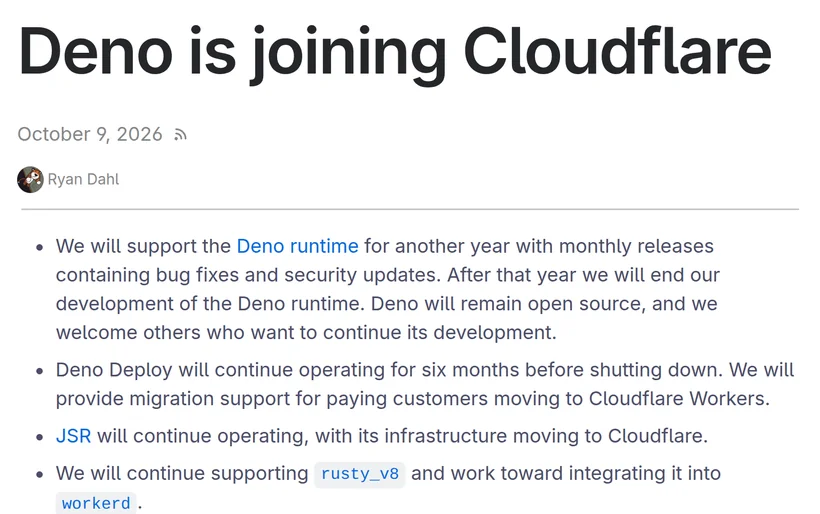
Screenshot of Deno's announcement, captured November 11, 2026, cropped to the title and the list of what changes.
What Deno has not stated, as of November 11, 2026:
- The exact shutdown date. Only "six months". About April 9, 2027 is our arithmetic, not Deno's.
- Whether signups are closed. The pricing page still shows "Free $0/month" with a "Start free" button.
- Migration help for free plans. The post promises it to "paying customers" only.
Don't mix this up with an older notice. Deno's Deploy docs still say "Deno Deploy Classic (dash.deno.com) and the subhosting v1 API will be shut down on July 20, 2026." That was Deploy Classic, a separate product. The October announcement covers the new Deno Deploy at console.deno.com.
How we ranked these Deno Deploy alternatives
We scored every entry on the same six criteria, each asking how close a host comes to what Deno Deploy did. Every row links to the vendor page we read on November 11, 2026.
| Criterion | Yes | Partial | No |
|---|---|---|---|
| Runs Deno code | A Deno.serve app that reads Deno.env runs unchanged, on a Deno-compatible runtime or on the Deno binary itself | A Deno-based runtime with its own handler, or the Deno binary through a beta container runtime | Deno APIs must be replaced |
| Global by default | Code runs close to each user in many locations without setup | You pick regions, and more than one region is a manual step or a paid feature | One region per service |
| $0 plan | $0 with no end date, no sleep or pause after idle time, no non-commercial clause and no billing account | One of those catches, or a small credit after a trial | A trial only, or none |
| Storage | A managed database or key-value store built into the platform, with a $0 allowance that does not expire | Storage that is paid only, expires, is in preview, or comes from a marketplace, a separate product or a disk volume | None |
| Cron | Built in on the $0 plan, every minute or faster, like Deno.cron on Deploy | Slower, paid only, trial only, a separate product, or the interval is not published | None found |
| Migration path | Deno or the vendor publishes a current guide or migration support for running Deno apps there | The vendor documents a Deno-based runtime but no guide | Neither |
Yes is worth 2 points, Partial 1 and No 0, for a total out of 12. The order of this list follows the totals. Ties go to the higher Runs Deno code score, then the higher $0 plan score, then the higher Migration score, then the alphabet. If one criterion matters more to you, re-rank by that column.
Best Deno Deploy alternatives: a quick overview
If you want to keep your Deno code and run at the edge:
- Supabase Edge Functions: best for Deno apps that can live next to Postgres, with cron down to one second.
- Cloudflare Workers: best for teams that want Deno's own migration target and a $0 plan with no pause.
- Netlify Edge Functions: best for Deno edge code that sits in front of a site on Netlify.
Bar chart of the requests or function invocations included each month on each $0 plan, read from vendor pages on 11 November 2026. Cloudflare Workers about 3 million (100,000 a day), Google Cloud Run 2 million, Deno Deploy Free 1 million (shutting down), Vercel Hobby 1 million invocations, Supabase 500,000 invocations.
- Cloudflare Workers100,000 a day (about 3M)
- Google Cloud Run2M requests
- Deno Deploy Free (shutting down)1M requests
- Vercel Hobby1M invocations
- Supabase Edge Functions500,000 invocations
Source: Cloudflare Workers pricing, Cloud Run pricing, Deno Deploy pricing, Vercel Hobby plan, Supabase Functions pricing. Checked Nov 11, 2026.
If you want to run the Deno binary in a container:
- Google Cloud Run: best for Deno apps in Docker with a large $0 monthly request allowance.
- Railway: best for deploying a repo with a
deno.jsonand no Dockerfile. - Fly.io: best for Deno apps that need specific regions and a disk for KV.
- Render: best for a Deno server in Docker in one region you pick.
If your app is part of a larger platform:
- Vercel Functions: best for Deno code next to a Next.js project, through the Container runtime (beta).
- Bunny Edge Scripting: best for edge scripts on a Deno-based runtime at a $1 monthly minimum.
Scores as of November 11, 2026. Yes = 2, Partial = 1, No = 0. Deno Deploy itself, for reference: Deno as is, 2 regions (US and EU), a $0 plan, Deno KV (1 GiB on Free) and Deno.cron every minute.
| Tool | Score (of 12) | Runs Deno code | Global | $0 plan | Storage | Cron | Migration path | Source |
|---|---|---|---|---|---|---|---|---|
| Supabase Edge Functions | 10 | YesDeno.serve, Deno.env, npm:, jsr: | Yes runs near the user | Partial pauses after a week idle | Yes Postgres 500 MB, Storage 1 GB | Yes down to 1 second | Partial Deno-compatible runtime, no guide | Supabase Edge Functions |
| Cloudflare Workers | 10 | No rewrite to a fetch handler | Yes hundreds of locations | Yes 100,000 requests a day | Yes KV, D1, SQLite Durable Objects | Yes every minute, 5 triggers | Yes Deno's migration support and Wrangler guide | Workers pricing |
| Netlify Edge Functions | 9 | Partial Deno runtime, Netlify handler | Yes edge location near each user | Yes 300 credits a month | Yes Blobs, Netlify Database | Partial Node functions only, interval not published | Partial Deno-based, no guide | Netlify Edge Functions API |
| Google Cloud Run | 8 | Yes Deno in Docker | Partial one region per service | Partial needs a billing account | Partial separate products | Partial Cloud Scheduler, 3 jobs | Yes Deno's Cloud Run guide | Cloud Run pricing |
| Railway | 8 | Yes Railpack detects deno.json | Partial multi-region on paid plans | Partial 30-day trial, then $1 credit a month | Partial 0.5 GB volume | Partial trial only | Yes Railpack Deno docs | Railway pricing |
| Fly.io | 7 | Yesfly launch detects Deno | Partial you pick regions | No no free tier | Partial volumes, paid | Partial hourly at most | Yes Fly's Deno guide | Fly.io pricing |
| Render | 5 | Yes Deno in Docker | No one region | Partial sleeps after 15 min idle | Partial free Postgres expires in 30 days | Partial cron jobs are paid | No no guide | Render free tier |
| Vercel Functions | 5 | Partial Container runtime (beta) | Partial multi-region on Pro | Partial Hobby is non-commercial | Partial Blob built in, databases via Marketplace | Partial every 15 min (beta) | No no guide | Vercel runtimes |
| Bunny Edge Scripting | 5 | Partial Deno-based, Bunny handler | Yes 119 PoPs | No 14-day trial, $1 minimum | Partial Bunny Database in preview | No none found | Partial Deno-based, no guide | Bunny scripting runtime |
1. Supabase Edge Functions, Best for Deno apps that can live next to Postgres
- Score
- 10/12
- $0 plan
- Partialpauses after a week idle
Supabase Edge Functions is a serverless functions product that runs TypeScript on the Supabase Edge Runtime, a "Deno compatible runtime", next to a Postgres database. Its own secrets example is a Deno.serve handler that reads Deno.env.get, so most Deno Deploy handlers move with few changes.

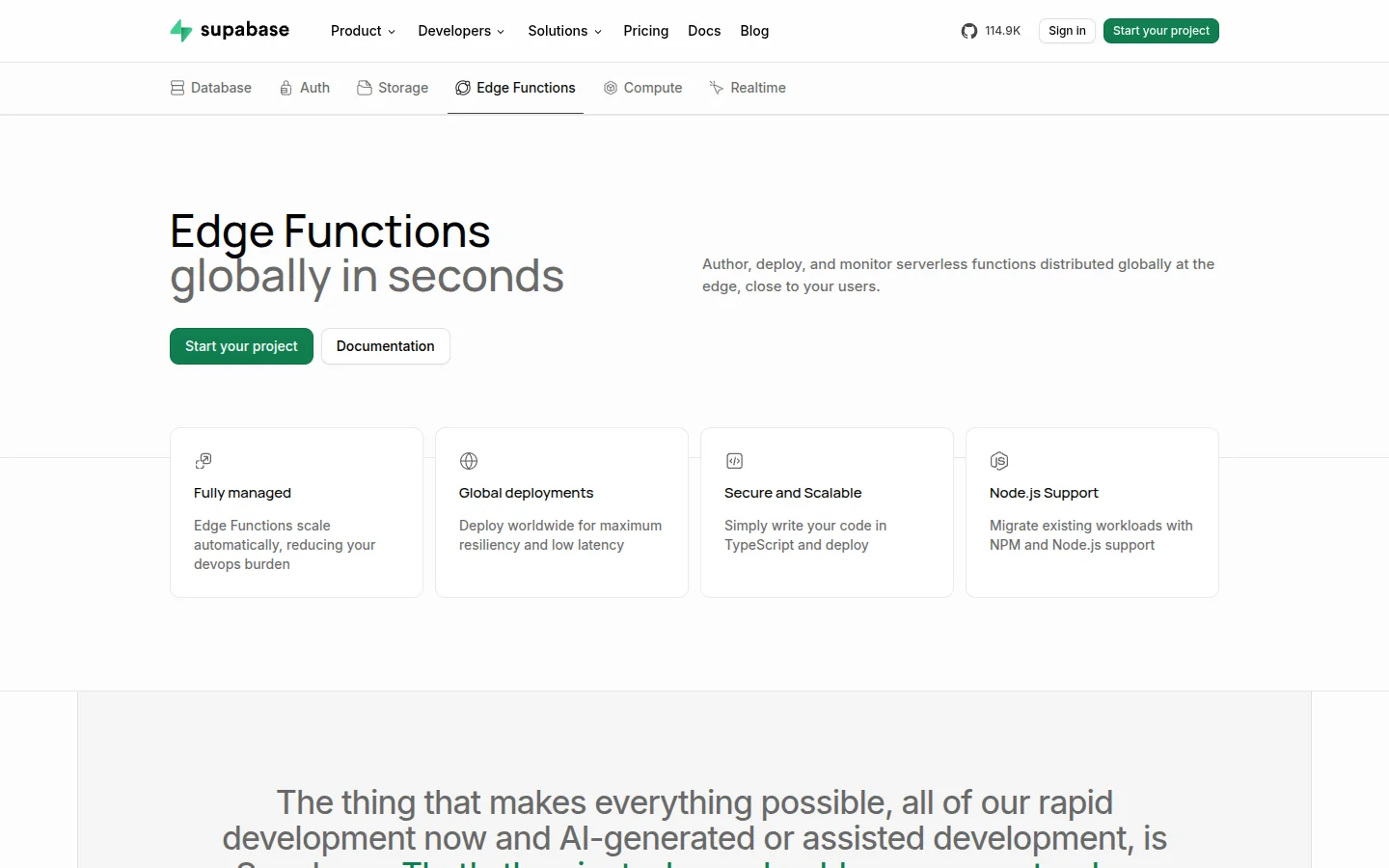
Screenshot of supabase.com/edge-functions, taken 2026-11-14.
Imports work the Deno way too. The dependencies docs show npm: and jsr: specifiers and a deno.json per function. What does not carry over is Deno KV and Deno.cron: we found neither in the Edge Functions docs, so KV data moves to Postgres and schedules move to Supabase Cron.
Key features
Deno.serve,Deno.env,npm:andjsr:imports- Runs in the region closest to the user
- Supabase Cron (pg_cron) can call a function "anywhere from every second to once a year", per Supabase's cron docs
- Postgres (500 MB) and Storage (1 GB) on the $0 plan
Best for
- Deno Deploy apps that want the fewest code changes
- Apps whose Deno KV data fits in Postgres tables
Pricing The $0 plan includes 500,000 function invocations a month and 2 active projects. Pro starts at $25 a month (as of November 2026, Supabase pricing).
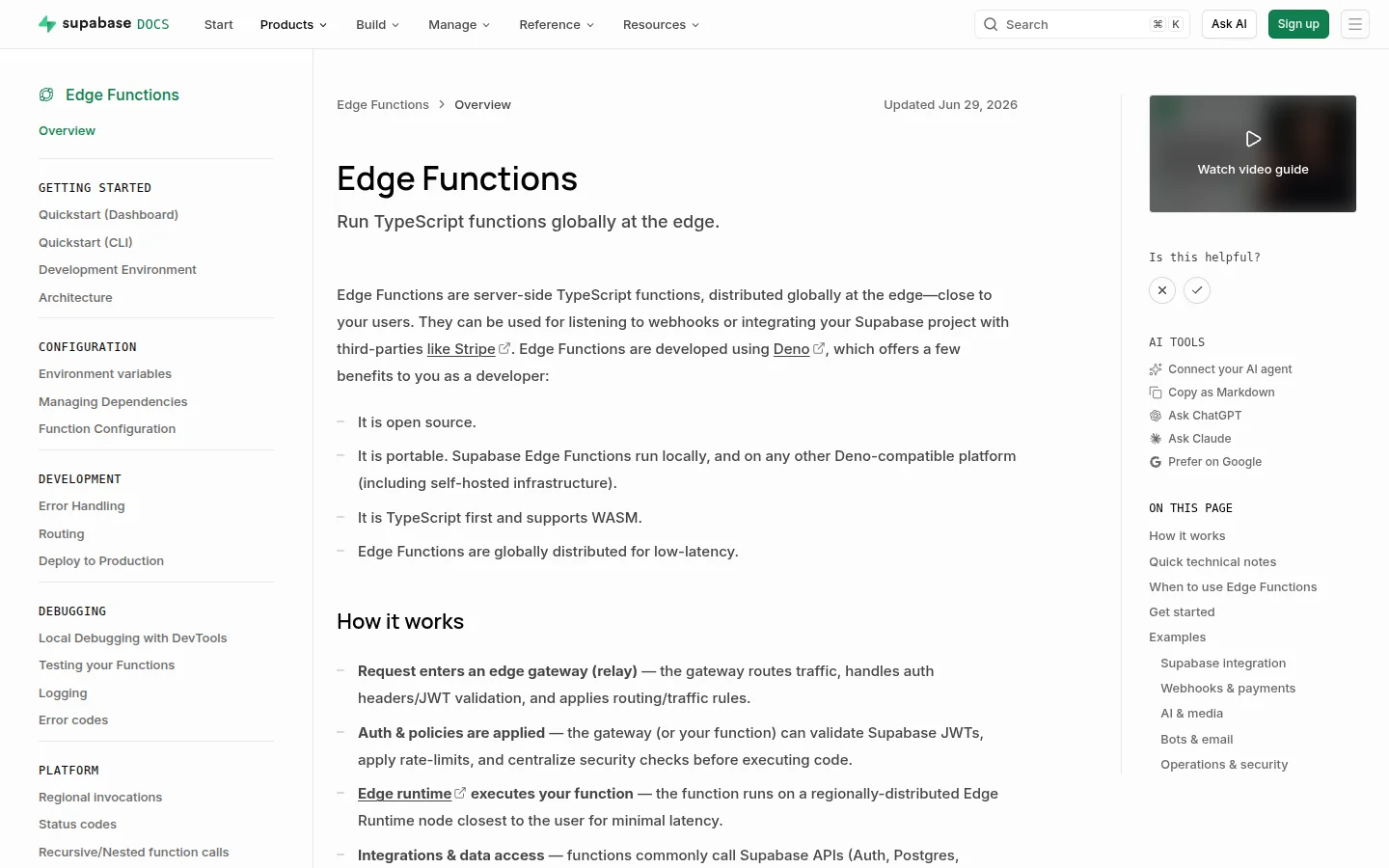
Screenshot of supabase.com/docs/guides/functions, taken 2026-11-14.
Pros
- The least rewriting on this list for a Deno Deploy app
- The most frequent cron here, on every plan
Cons
- "Free projects are paused after 1 week of inactivity"
- No key-value store, so Deno KV code moves to SQL
- No Deno Deploy migration guide
2. Cloudflare Workers, Best for Deno's own migration target and a $0 plan with no pause
- Score
- 10/12
- $0 plan
- Yes100,000 requests a day
Cloudflare Workers is a serverless platform that runs JavaScript and TypeScript on V8 isolates across Cloudflare's network, with KV, D1, R2, Durable Objects and Cron Triggers on the same account. It is where Deno sends its paying customers: "We will provide migration support for paying customers moving to Cloudflare Workers."

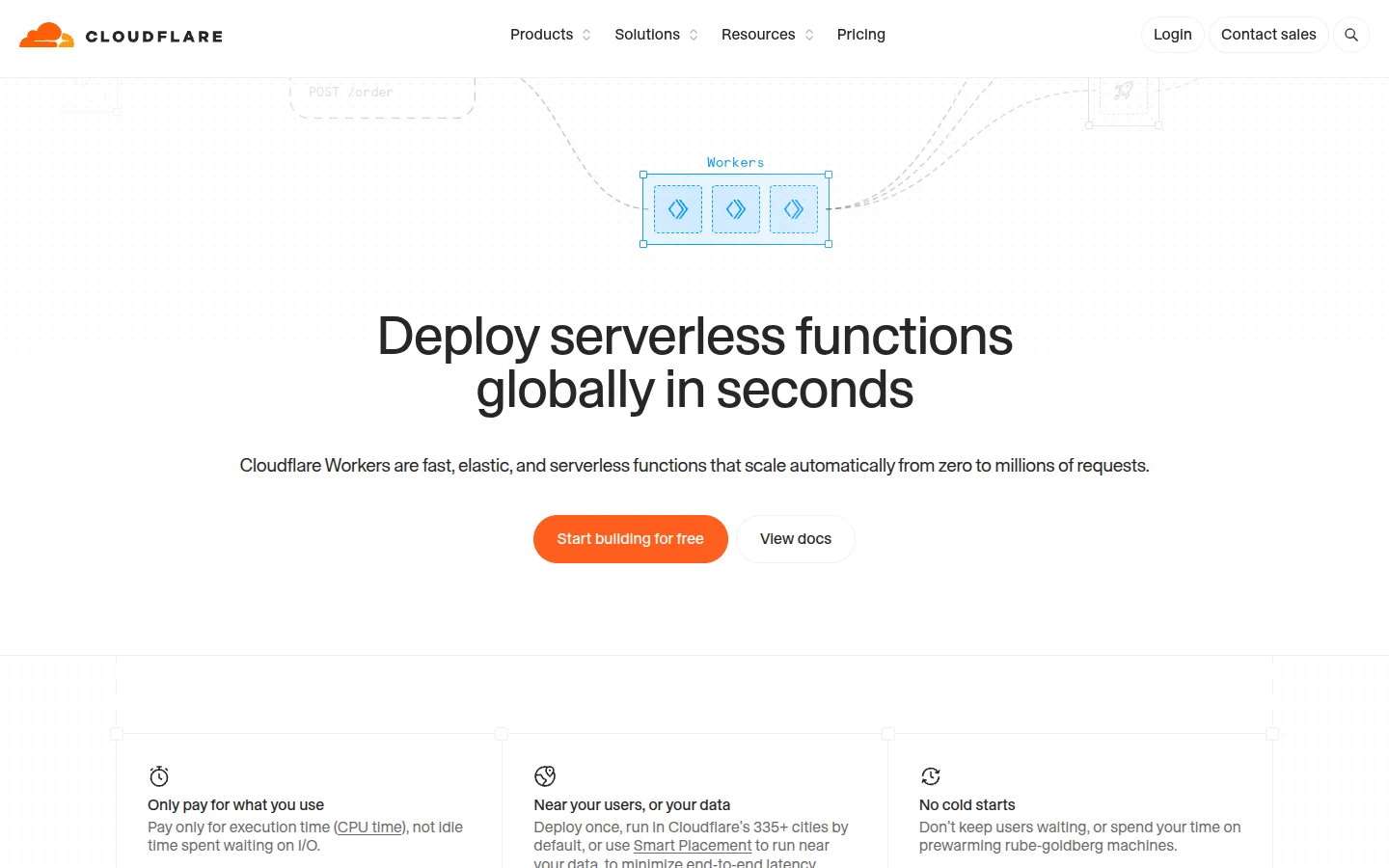
Screenshot of workers.cloudflare.com, taken 2026-11-14.
The catch is code. No page in Cloudflare's docs mentions Deno, so Deno.serve, Deno.env, Deno.openKv and Deno.cron all need replacing with a fetch handler, env bindings and a scheduled() handler. Deno's own Wrangler tutorial shows the setup, and Node.js APIs are on by default for new projects.
Key features
- Runs "in a data center closest to where the request was received", per Cloudflare's placement docs
- Cron Triggers down to every minute, 5 per account on the $0 plan
- SQLite-backed Durable Objects on the $0 plan with 5 GB, plus KV (1 GB), D1 and R2
Best for
- Paying Deno Deploy customers who want Deno's migration help
- Apps with heavy traffic on a $0 or $5 budget
Pricing The $0 plan includes 100,000 requests a day and 10 ms of CPU time per invocation. Workers Paid is $5 a month per account (as of November 2026, Cloudflare Workers pricing).
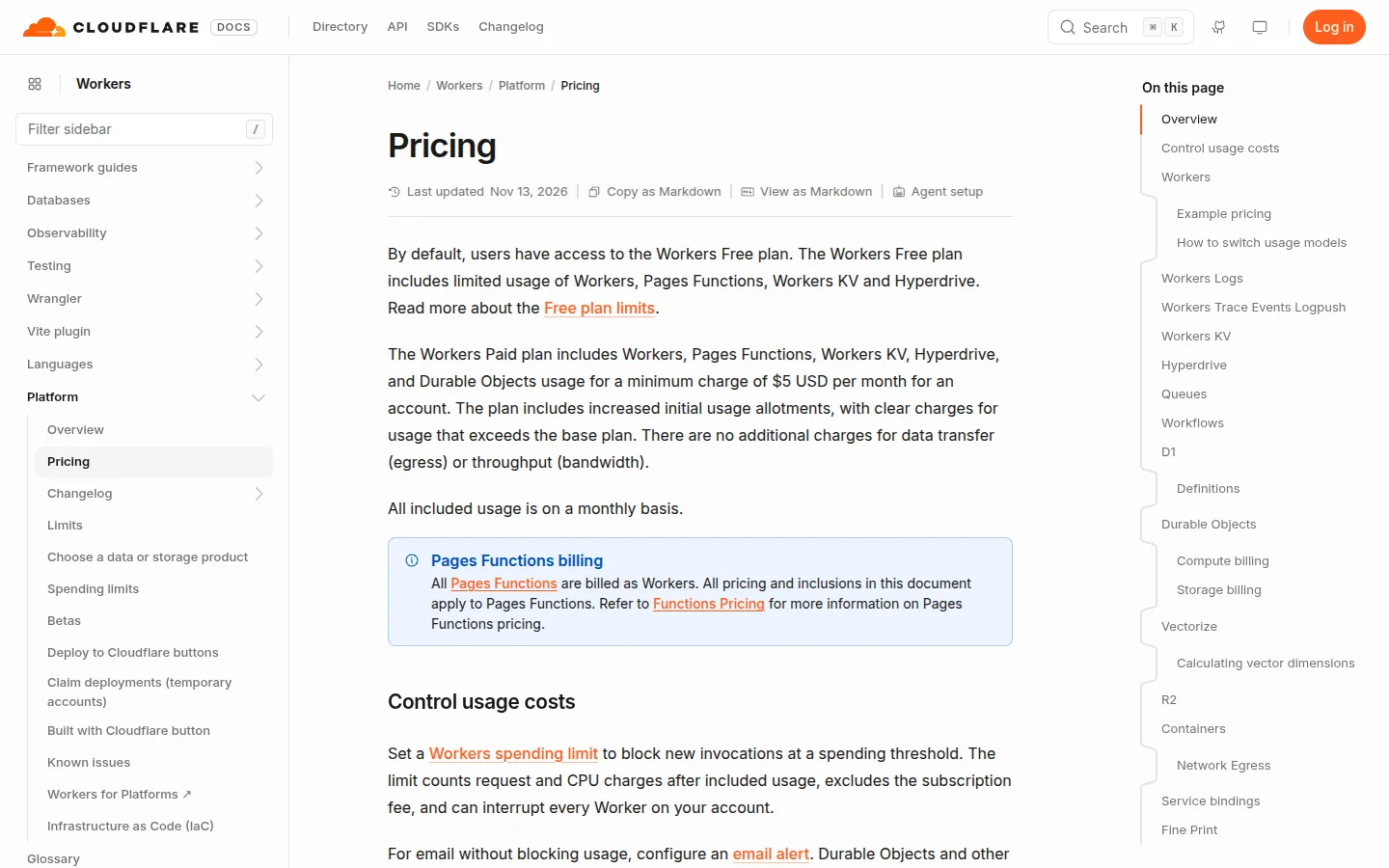
Screenshot of developers.cloudflare.com/workers/platform/pricing, taken 2026-11-14.
Pros
- No pause, no sleep and no non-commercial clause on the $0 plan
- Isolates, which Cloudflare says remove the cold starts of a virtual machine model
Cons
- Every Deno API needs rewriting
- Workers KV is "eventually-consistent" and "not ideal" for atomic operations, per How KV works. Deno KV is strongly consistent, so Durable Objects are the closer match.
- 10 ms of CPU per call on the $0 plan
3. Netlify Edge Functions, Best for Deno edge code in front of a site on Netlify
- Score
- 9/12
- $0 plan
- Yes300 credits a month
Netlify Edge Functions is an edge functions product that runs TypeScript and JavaScript "in a secure runtime based on Deno", per Netlify's overview. It is the closest runtime match after Supabase, though the handler and env access are Netlify's own.
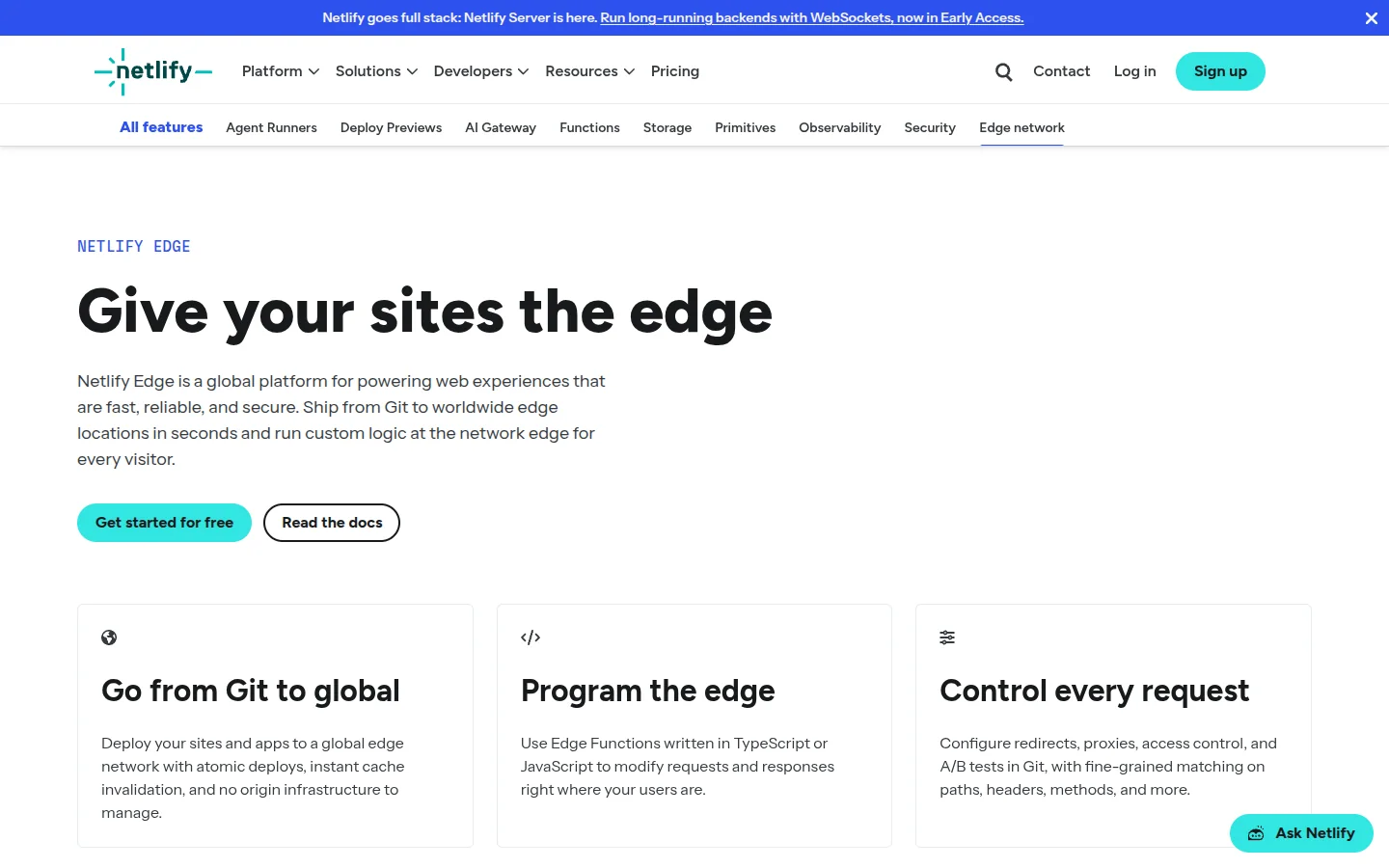
Screenshot of netlify.com/platform/core/edge, taken 2026-11-14.
A function exports async (request, context) from @netlify/edge-functions and reads env vars with Netlify.env, per the API docs. Deno modules load by URL or an import map, and npm support is in beta. Edge functions can't be scheduled, so cron jobs move to regular Netlify Functions on Node.js.
Key features
- Deno runtime with standard Web APIs, at the edge location nearest each user
- Netlify Blobs, usable as a key-value store, and Netlify Database
- 50 ms of CPU per request and 20 MB of code after compression
Best for
- Deno Deploy apps that rewrite or route requests in front of a static site
- Teams that already deploy a frontend on Netlify
Pricing The $0 plan has 300 credits a month with a hard limit, and a project that hits it pauses until the next billing cycle. Personal is $9 a month with 1,000 credits (as of November 2026, Netlify pricing).
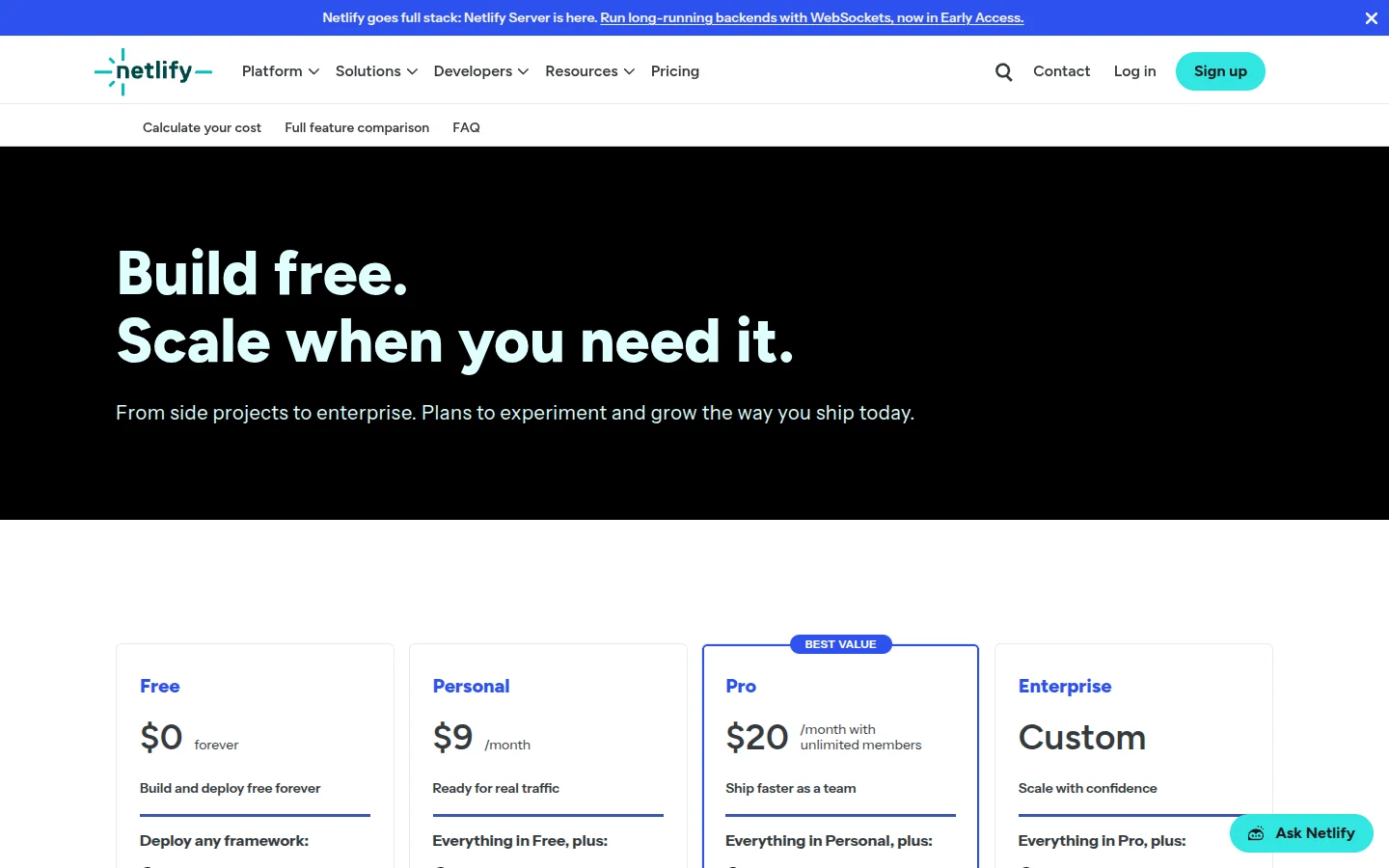
Screenshot of netlify.com/pricing, taken 2026-11-14.
Pros
- A Deno-based runtime at the edge on a $0 plan with no idle pause
- Blobs give Deno KV users a key-value store
Cons
- No
Deno.serve,Deno.env,npm:orjsr:in the docs we read - No cron on edge functions, and no published minimum interval for scheduled functions
- "If one project exceeds its limits, all projects on your account will be paused"
4. Google Cloud Run, Best for Deno apps in Docker with a large $0 allowance
- Score
- 8/12
- $0 plan
- Partialneeds a billing account
Google Cloud Run is a managed container platform that runs any HTTP server from a Docker image, including the Deno binary. Deno publishes a Cloud Run guide that packages a Deno app with Docker, so your code runs as it did on Deploy.

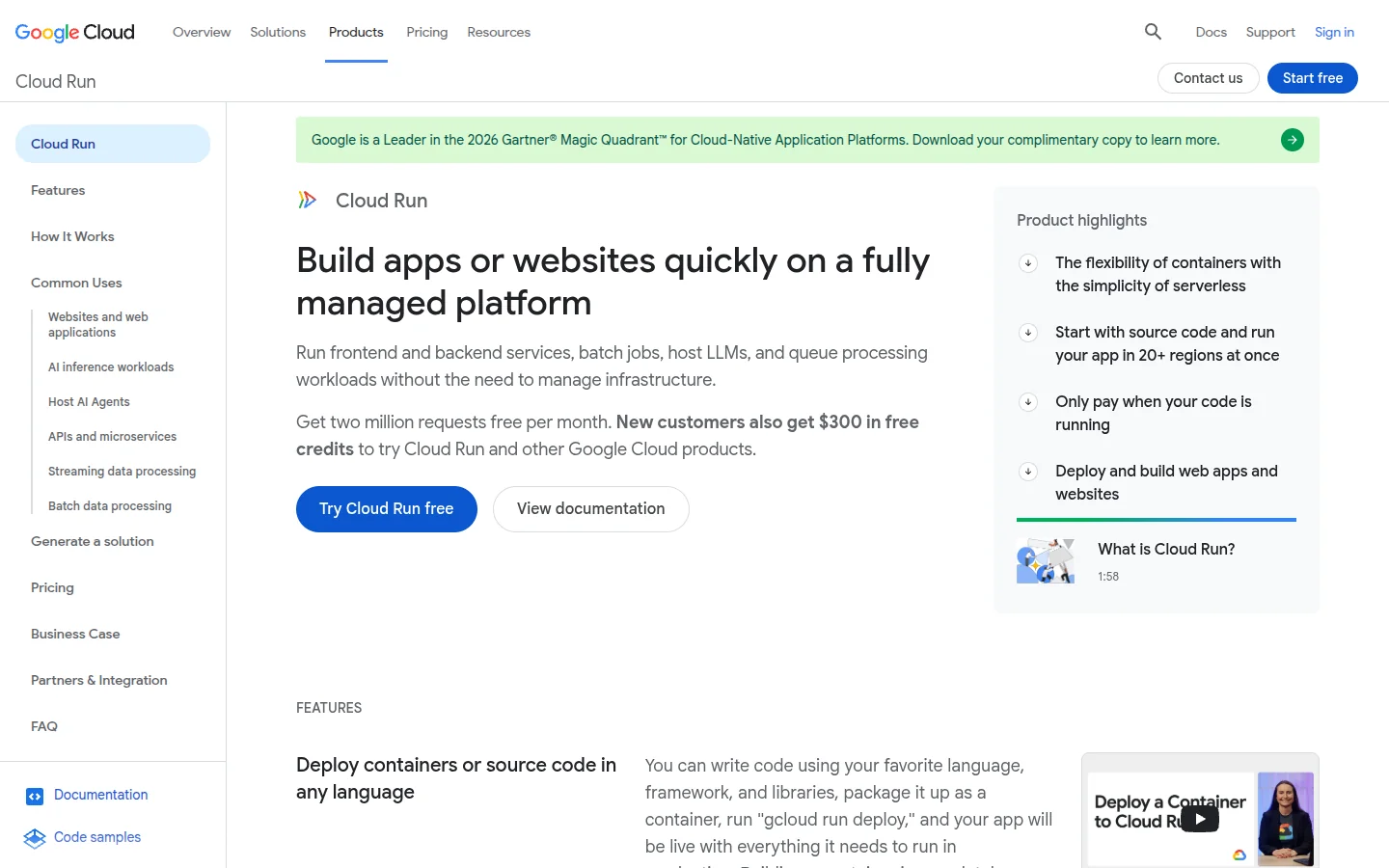
Screenshot of cloud.google.com/run, taken 2026-11-14.
Cloud Run deploys each service into one region. For global traffic you deploy to several regions and set up a global load balancer, per Google's multi-region docs. Deno KV and Deno.cron need replacements: Google sells storage and Cloud Scheduler as separate products.
Key features
- Any Deno version in your own container
- 2 million requests a month in the free tier with request-based billing
- Cloud Scheduler for cron, with unix-cron syntax and 3 free jobs per billing account
Best for
- Teams already on Google Cloud
- Deno apps with spiky traffic that scale to zero
Pricing
| Included | Per month |
|---|---|
| Requests | 2 million |
| vCPU-seconds | 180,000 |
| GiB-seconds | 360,000 |
| Beyond that | Pay per use, with no flat plan |
The free tier is aggregated per billing account (as of November 2026, Cloud Run pricing).
Pros
- Deno's own guide, and no code changes beyond a Dockerfile
- The second-largest $0 request allowance on this list
Cons
- Needs a billing account, even for the free tier
- One region per service unless you build multi-region yourself
- Storage and cron are separate products to set up and price
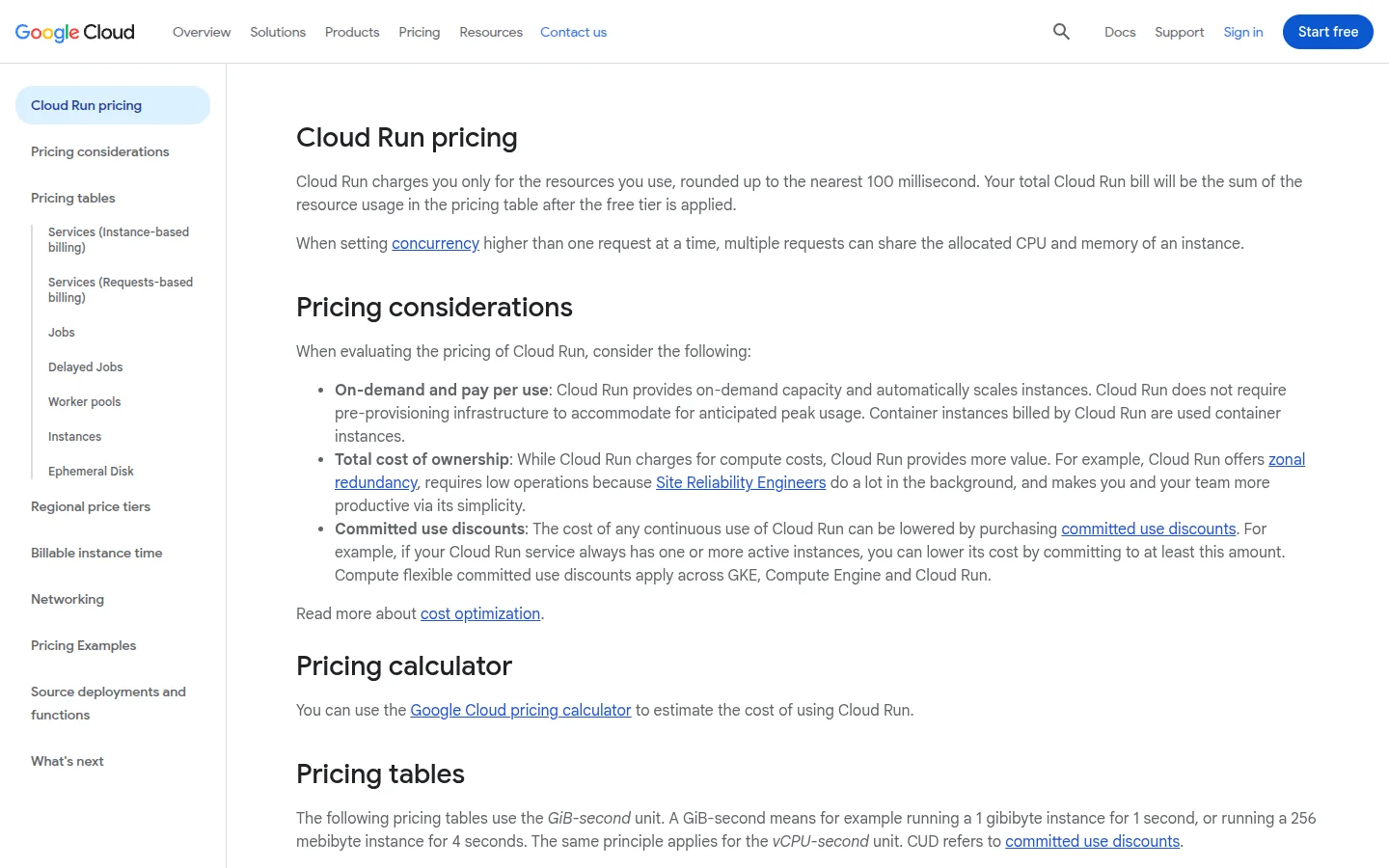
Screenshot of cloud.google.com/run/pricing, taken 2026-11-14.
5. Railway, Best for deploying a repo with a deno.json and no Dockerfile
- Score
- 8/12
- $0 plan
- Partial30-day trial, then $1 credit a month
Railway is a cloud platform that builds and runs services from a Git repo. Its builder, Railpack, "builds and deploys Deno applications with zero configuration" when it finds a deno.json, per the Railpack Deno docs, and runs your file with deno run --allow-all.

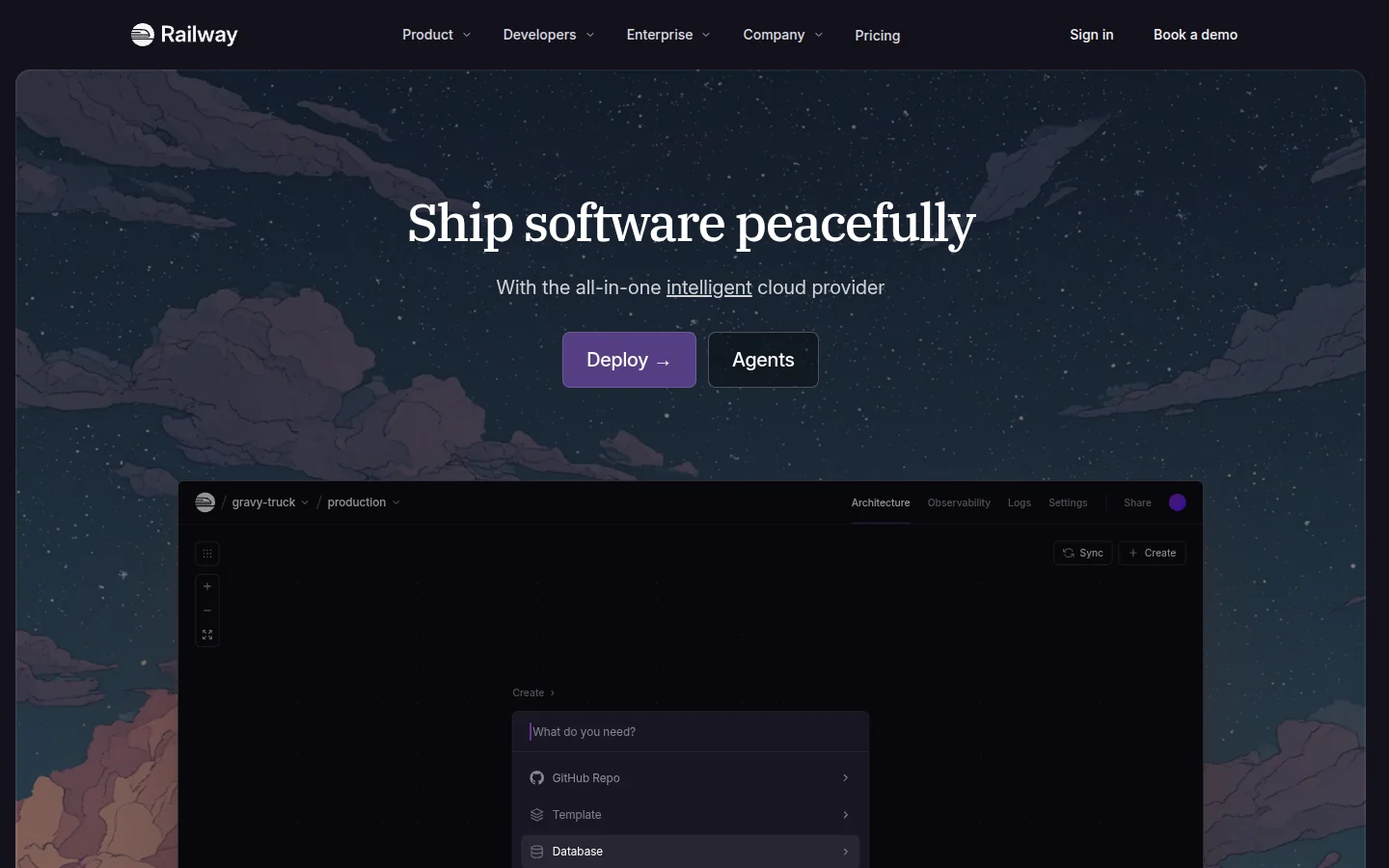
Screenshot of railway.com, taken 2026-11-14.
You pick one region per service. Multi-region replicas, where "Railway will automatically route public traffic to the nearest region", come with paid plans, per Railway's scaling docs.
Key features
- Deno detected from
deno.jsonordeno.jsonc - Volumes, S3-compatible Buckets and a one-click Postgres template
- Cron on any service, at least 5 minutes apart
Best for
- Deno servers that read and write files or run subprocesses
- Teams that want a repo-to-URL deploy without writing a Dockerfile
Pricing New accounts get a 30-day trial with $5 of credit, then $1 of credit a month on Free. Hobby is $5 a month with $5 of usage included (as of November 2026, Railway pricing).
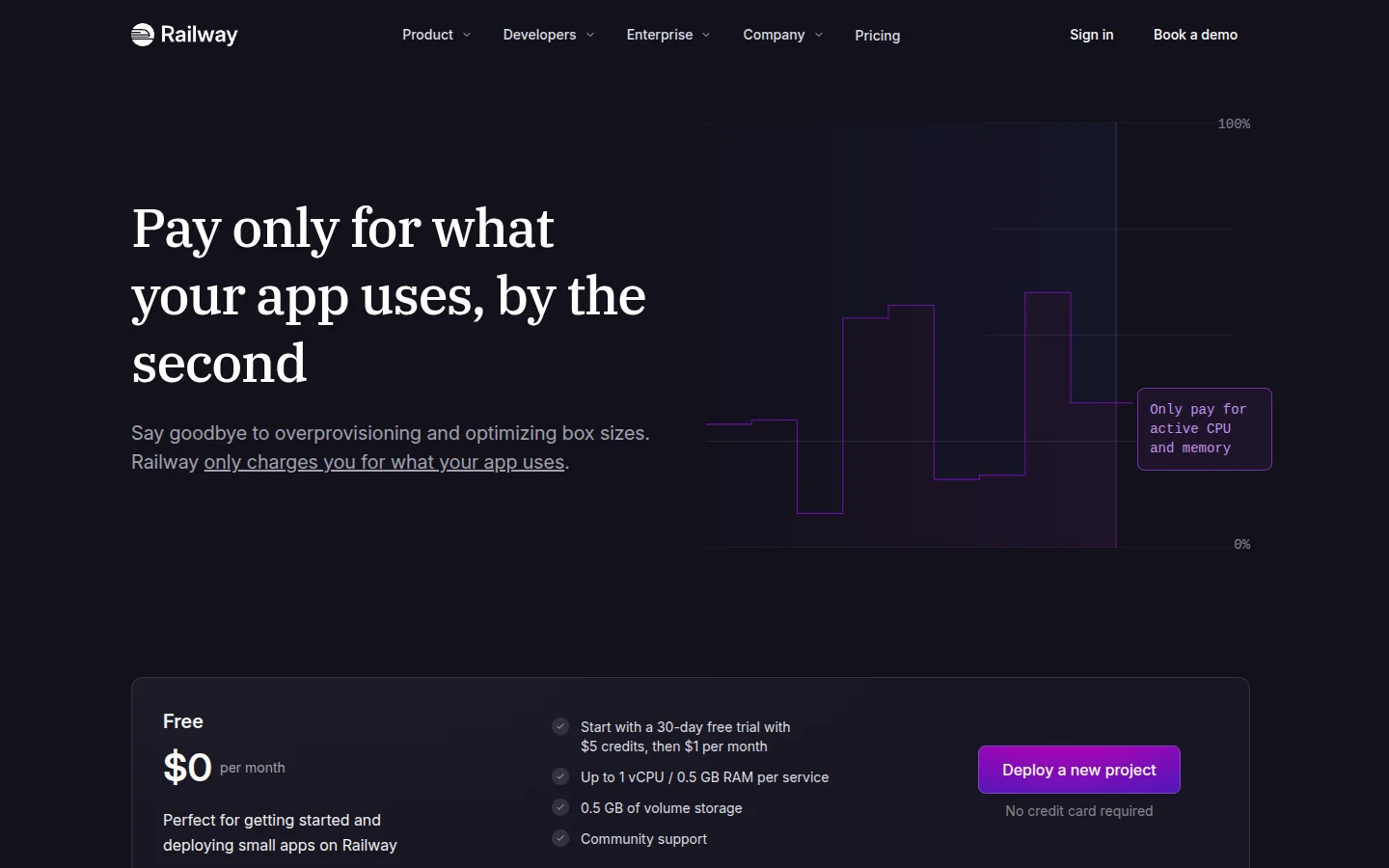
Screenshot of railway.com/pricing, taken 2026-11-14.
Pros
- No Dockerfile and no code changes for a Deno server
- A $5 plan with multi-region replicas
Cons
- Cron jobs on Free are trial only
- No managed key-value store, so Deno KV becomes Postgres or SQLite on a volume
- No Deno Deploy migration guide
6. Fly.io, Best for Deno apps that need regions you pick and a disk for KV
- Score
- 7/12
- $0 plan
- Nono free tier
Fly.io is a cloud platform that runs apps as containers on Fly Machines in regions you choose. Fly's Deno guide packages a Deno server in a Docker image, and fly launch prints "Detected Deno app".


Screenshot of fly.io, taken 2026-11-14.
Fly once wrote a blueprint for exactly this move, porting a Deno Deploy app that uses Deno KV. It is now marked deprecated because it depends on a product "retired on October 15, 2024", per the blueprint. Its core idea still holds: Deno.openKv(path) can store KV in SQLite on a volume.
Key features
- 18 regions, and
fly scale countto spread Machines across them - Volumes for SQLite-backed Deno KV on one Machine
- Secrets set with
fly secrets set
Best for
- Deno apps that need a specific region or several
- Developers comfortable with containers and volumes
Pricing New organizations have no free tier, and new accounts get $1 of credit for 7 days. The cheapest always-on Machine costs $2.19 per 30 days (as of November 2026, Fly.io pricing).
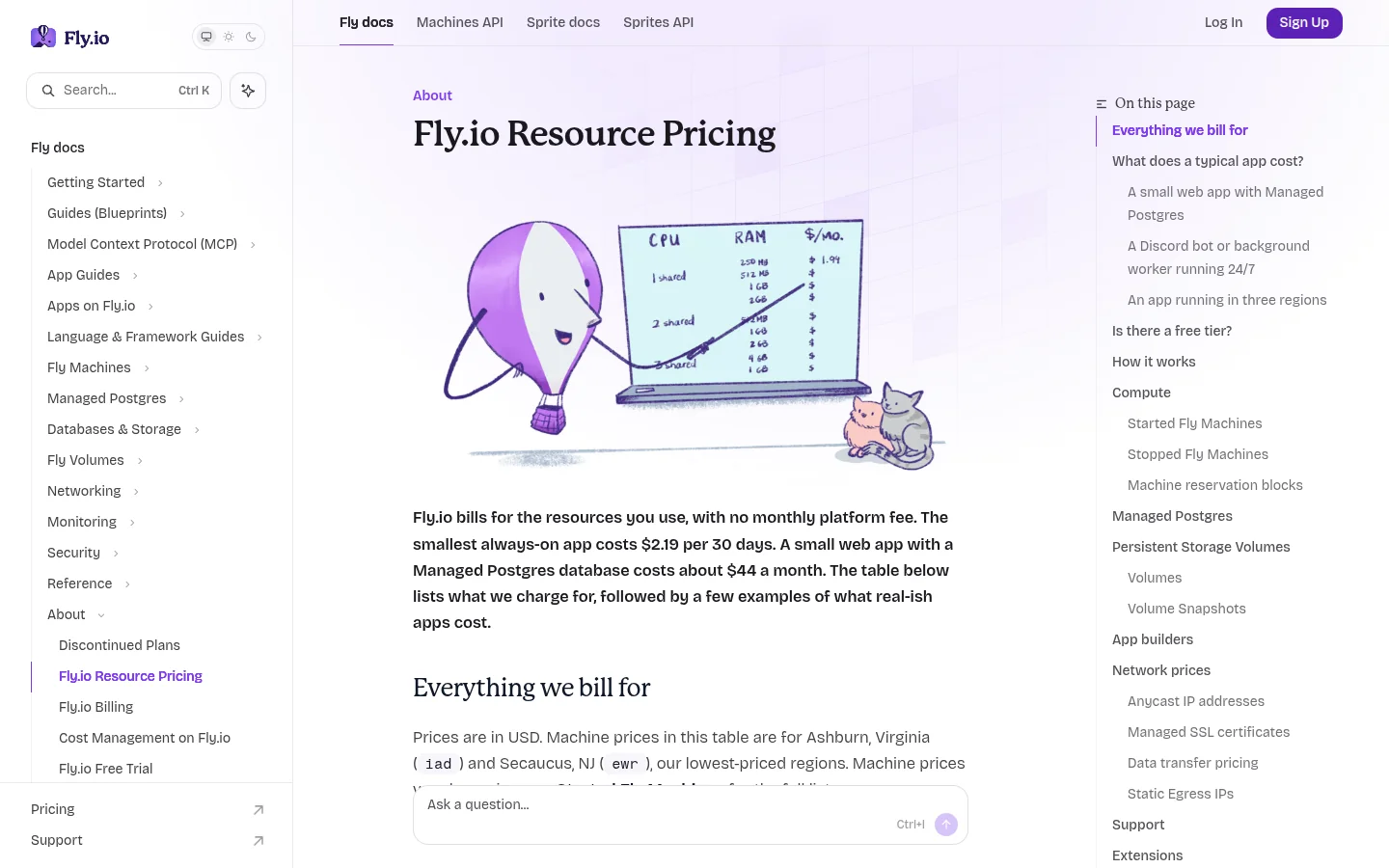
Screenshot of fly.io/docs/about/pricing, taken 2026-11-14.
Pros
- Real Deno, real files, any region
- Low cost for one small always-on app
Cons
- No free tier
- Built-in schedules run hourly at most, per flyctl docs
- KV on a volume lives on one Machine unless you replicate it yourself
7. Render, Best for a Deno server in Docker in one region
- Score
- 5/12
- $0 plan
- Partialsleeps after 15 min idle
Render is a cloud hosting platform for web services, workers, cron jobs and databases. Deno is not one of its native runtimes, so a Deno app runs from a Docker image, per Render's language support.

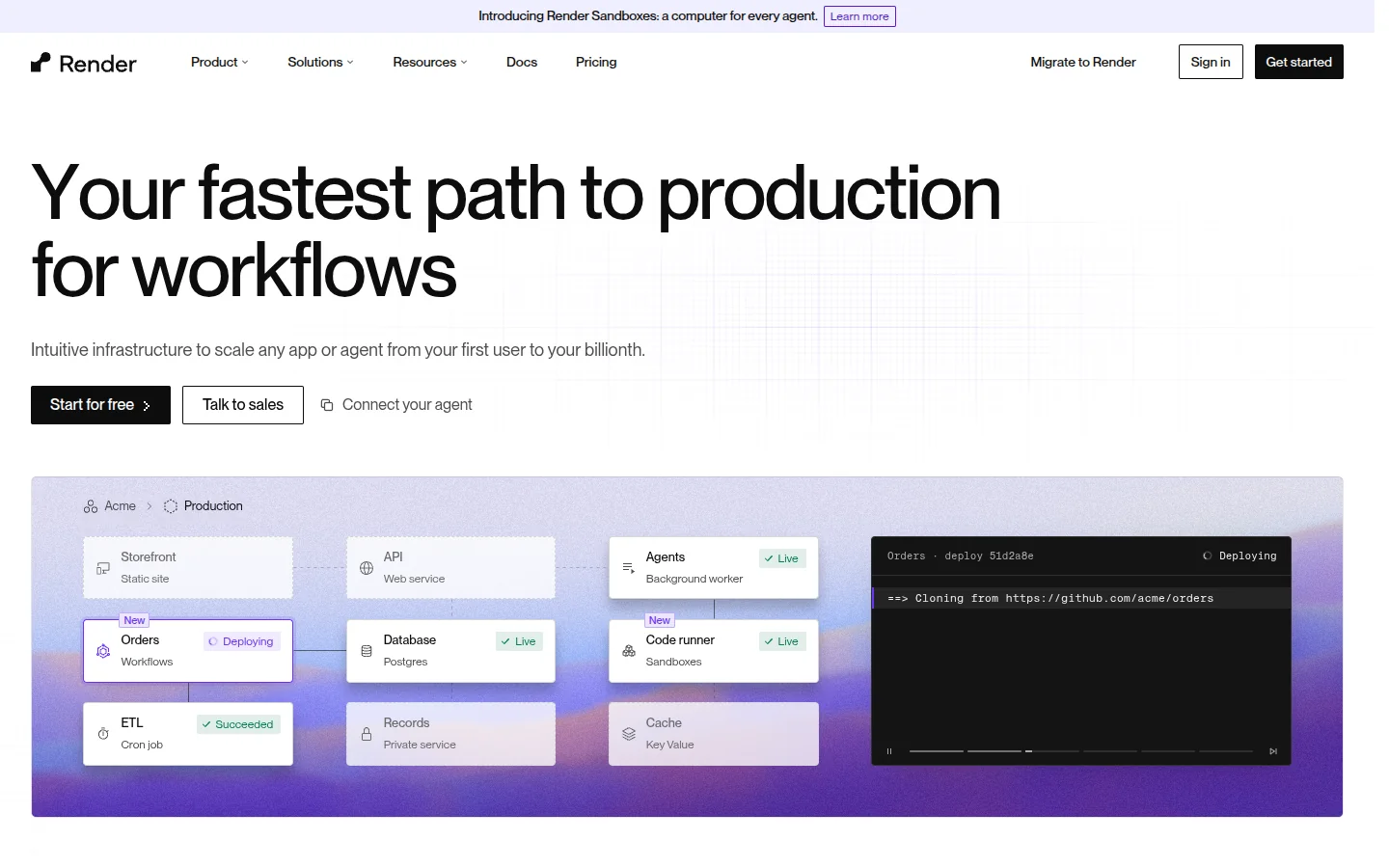
Screenshot of render.com, taken 2026-11-14.
You pick a region when you create a service, and "Render doesn't currently support changing the region for an existing service", per Render's regions docs. That makes it a step back from Deploy's two regions.
Key features
- Docker web services, background workers and cron jobs
- Postgres, Key Value and persistent disks
- 5 regions: Oregon, Ohio, Virginia, Frankfurt and Singapore
Best for
- Deno apps that became long-running servers with workers
- Teams that want a fixed monthly price per service
Pricing Free web services have 512 MB of RAM and sleep after 15 idle minutes. A paid instance starts at $7 a month, and each cron job costs at least $1 a month (as of November 2026, Render pricing).
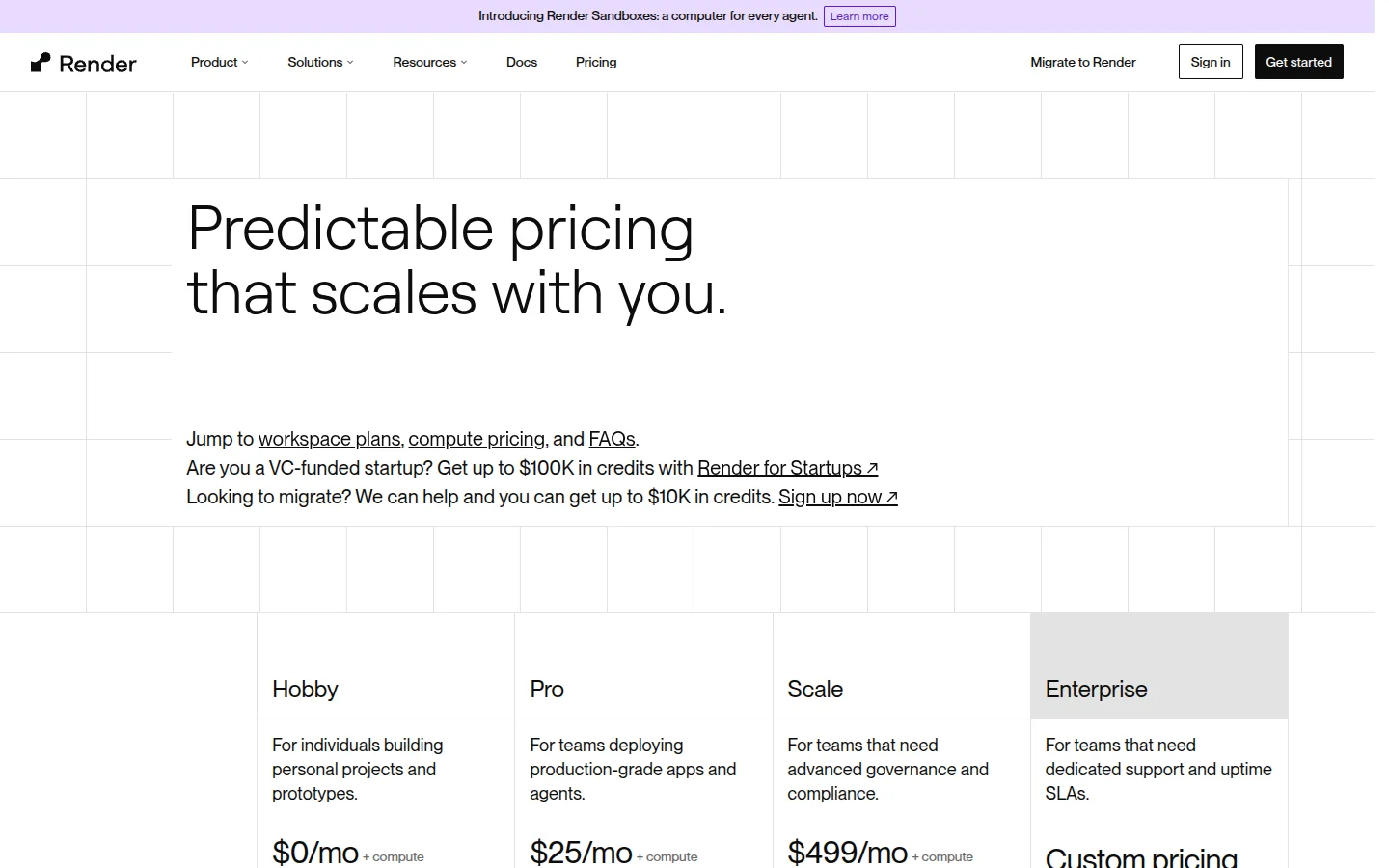
Screenshot of render.com/pricing, taken 2026-11-14.
Pros
- Runs the real Deno binary in your own image
- Cron jobs, workers and databases in one dashboard
Cons
- One region per service, fixed at creation
- Free Postgres expires 30 days after creation, and free services take about a minute to wake
- No cron on the $0 plan and no Deno guide
8. Vercel Functions, Best for Deno code next to a Next.js project
- Score
- 5/12
- $0 plan
- PartialHobby is non-commercial
Vercel Functions is a serverless functions product with Node.js, Bun, Python and other runtimes, but no Deno runtime. The new Container runtime, in beta on all plans, "runs any code and library from an OCI container image", per Vercel's runtimes page, which is how a Deno server can run there.

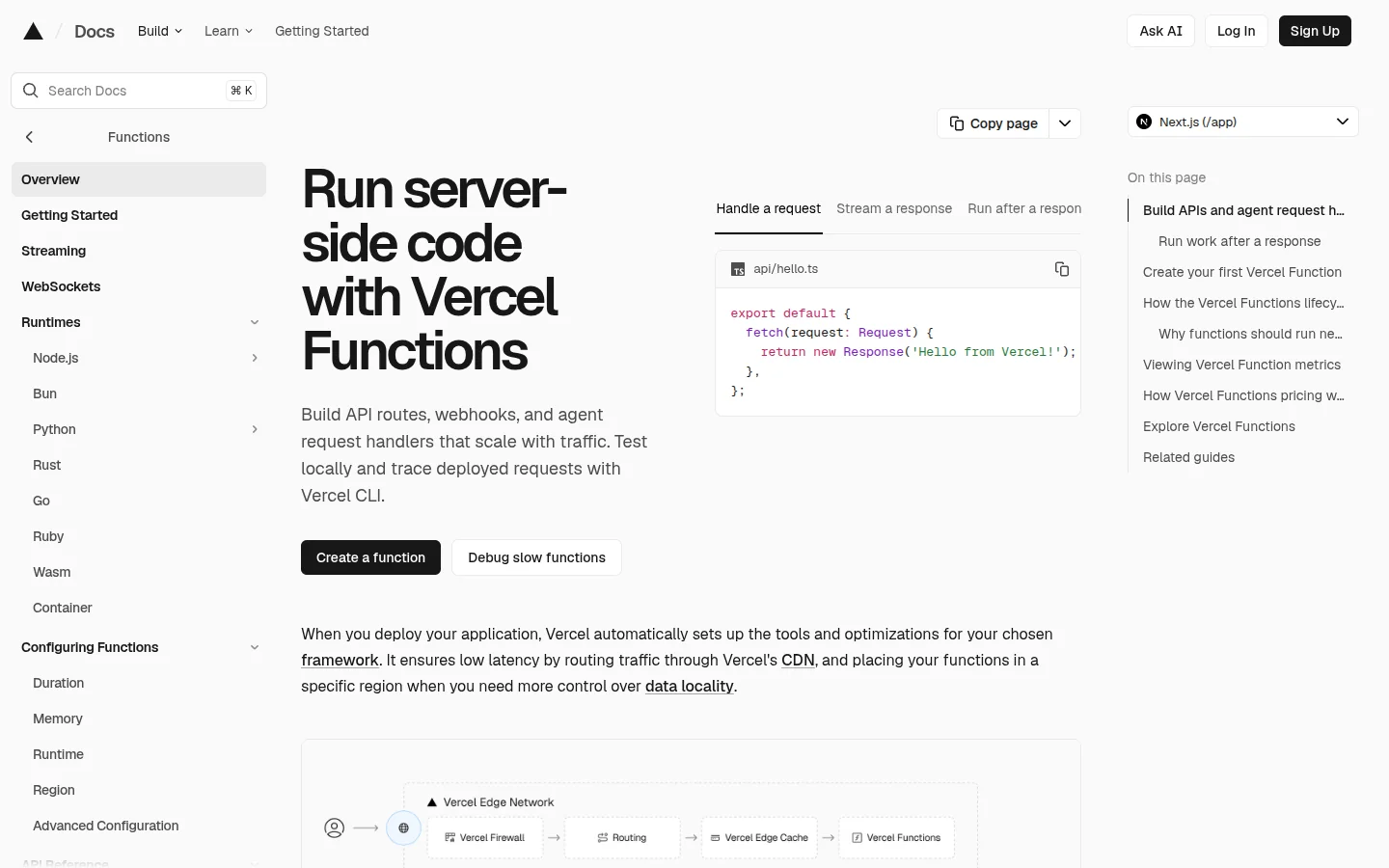
Screenshot of vercel.com/docs/functions, taken 2026-11-14.
Functions run in one region by default (iad1). "Pro and Enterprise teams can deploy Vercel Functions to multiple regions", per the region docs.
Key features
- Container runtime (beta) for a Deno image on port 80
- Vercel Blob built in, with SQL and key-value stores through the Marketplace
- Schedules (beta): every 15 minutes on Hobby, every minute on Pro
Best for
- Deno API routes that belong to a frontend already on Vercel
- Personal projects that fit the Hobby limits
Pricing Hobby is $0 with 1 million function invocations a month, for non-commercial, personal use only. Pro is $20 a month per paid seat with $20 of usage credit (as of November 2026, Vercel pricing).
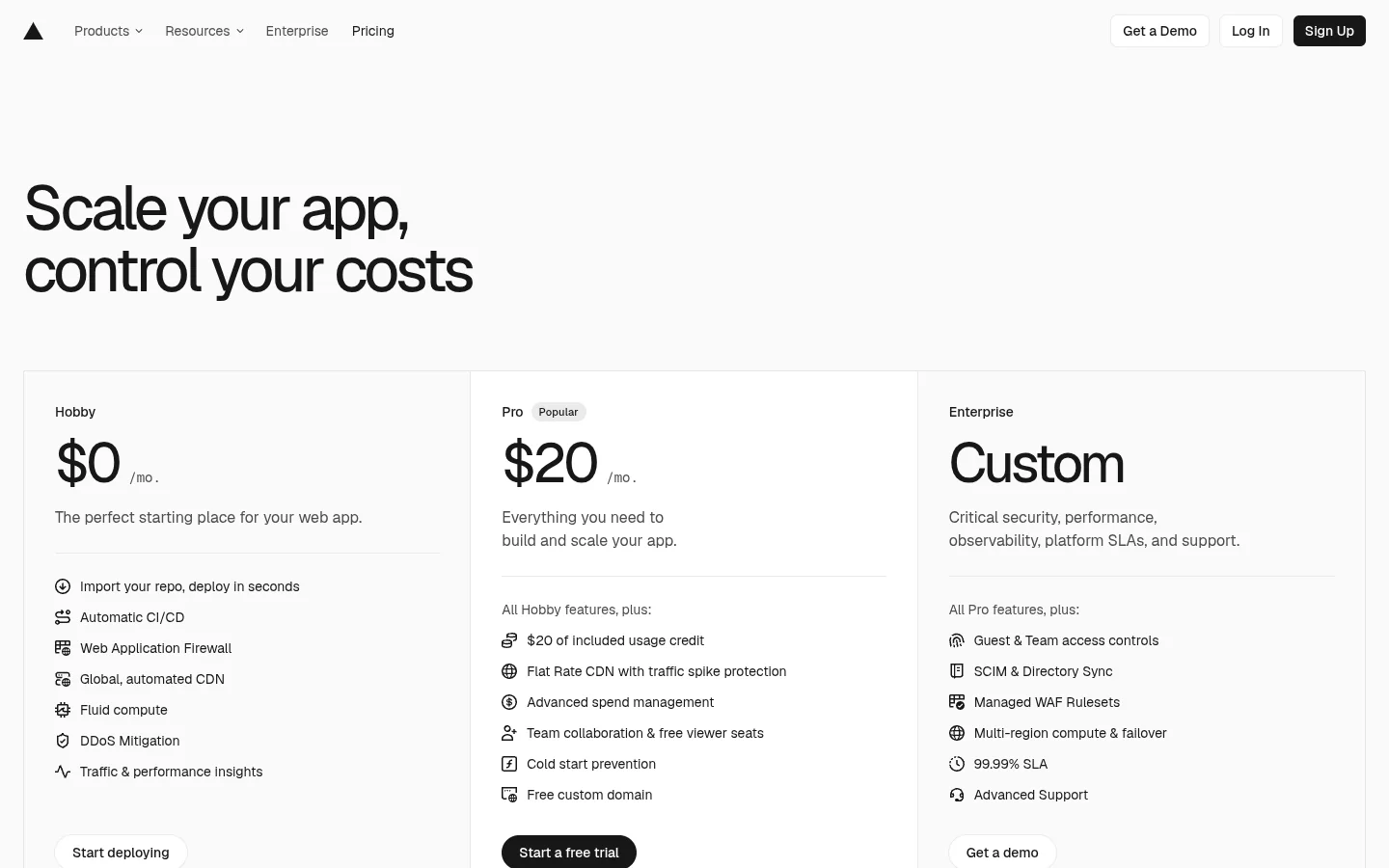
Screenshot of vercel.com/pricing, taken 2026-11-14.
Pros
- One platform for the frontend and the Deno service
- Containers scale down after 5 minutes without traffic in production
Cons
- Deno runs only through a beta container runtime
- Hobby is non-commercial, and multi-region needs Pro
- No first-party key-value store
9. Bunny Edge Scripting, Best for edge scripts on a Deno-based runtime at a $1 minimum
- Score
- 5/12
- $0 plan
- No14-day trial, $1 minimum
Bunny Edge Scripting is an edge compute product from the CDN bunny.net that "runs on Deno and V8", per Bunny's scripting docs. Scripts run across its CDN network, and Deno.env works for environment variables.


Screenshot of bunny.net/edge-scripting, taken 2026-11-14.
Bunny's runtime page speaks to the Deno news directly: "With Deno winding down active development, we want to reassure you that nothing changes for Edge Scripting." It adds that it is "evaluating our long-term options" for the runtime.
Key features
- A Deno-based runtime with a
BunnySDK.net.http.servehandler - 119 points of presence on the standard network
- Bunny Database, a SQLite-compatible database in public preview
Best for
- Edge logic in front of a site that already uses Bunny CDN
- Small scripts where a $1 monthly minimum beats a $5 plan
Pricing There is no $0 plan: new accounts get a 14-day trial, then a $1 monthly minimum. Scripting costs $0.20 per million requests and $0.02 per 1,000 seconds of CPU time (as of November 2026, Bunny pricing and Scripting pricing).

Screenshot of bunny.net/pricing, taken 2026-11-14.
Pros
- A Deno-based runtime at the edge
- 30 seconds of CPU per request
Cons
- No cron for Edge Scripting in Bunny's docs
- The runtime's future after Deno's support year is not stated
- No
Deno.serve,npm:orjsr:in the docs we read
What we left out, and why
| Left out | Why |
|---|---|
| AWS Lambda | It has no Deno runtime. Deno's Lambda guide goes through a container image, and Cloud Run covers that pattern with a larger $0 allowance. |
| Fastly Compute | It runs WebAssembly, and JavaScript goes through Fastly's own SDK, not Deno. |
| Self-hosting Deno | Deno stays open source, but monthly fixes end a year after October 9, 2026. Railway, Fly.io, Render and Cloud Run run the same binary for you. |
| Val Town and Pipedream Workflows | Both are shutting down too. We ranked Val Town alternatives and Pipedream alternatives separately. |
Every dated developer shutdown we found, with the vendor's own words, is in our developer service shutdown tracker.
How to migrate off Deno Deploy before it shuts down
Deno has not published a date or a "leave Deploy" guide, so plan as if the six months end around April 9, 2027, and finish early. These steps come from Deno's docs and each host's own pages.
- List your apps, KV databases and cron jobs. On the new Deploy, cron jobs live in your code (
Deno.cron) and KV is attached as a database in the console. - Export KV data. No vendor we checked imports Deno KV, and Deno documents no export command. Deno does document opening a hosted KV from a local Deno CLI with
Deno.openKv("https://api.deno.com/v2/databases/<Database ID>/connect")and aDENO_KV_ACCESS_TOKEN, per its KV docs. From there you can list keys and write them to the new store. That export step is our reading, not a Deno-documented procedure. - Pick the new store. Deno KV is strongly consistent. Cloudflare KV is not, so use SQLite-backed Durable Objects or D1 on Cloudflare.
- Map each
Deno.cron. Here is each host's store and cron:
| Host | Instead of Deno KV | Instead of Deno.cron |
|---|---|---|
| Cloudflare | SQLite-backed Durable Objects or D1 | A scheduled() handler plus crons in Wrangler config |
| Supabase | Postgres | Supabase Cron |
| Netlify | Blobs | A scheduled Node.js function |
| Fly.io | Deno.openKv(path) on a volume | |
| Railway | Deno.openKv(path) on a volume | A cron service |
| Render | A cron service | |
| Cloud Run | Cloud Scheduler |
- Move env vars and secrets. Deploy separates Production and Development contexts. Copy each, then use
wrangler secret put,supabase secrets set,fly secrets setorrailway variable set. On Cloudflare and Netlify,Deno.env.getbecomes theenvbinding orNetlify.env.get. - Change the handler only where you must. On Supabase, Railway, Fly.io, Render and Cloud Run,
Deno.servestays. On Cloudflare it becomesexport default { fetch }. On Netlify it becomesexport default async (request, context). - Point domains last. Move DNS after the new host serves real traffic. If you pay for Deploy, ask Deno for the migration support it promised for Cloudflare Workers.
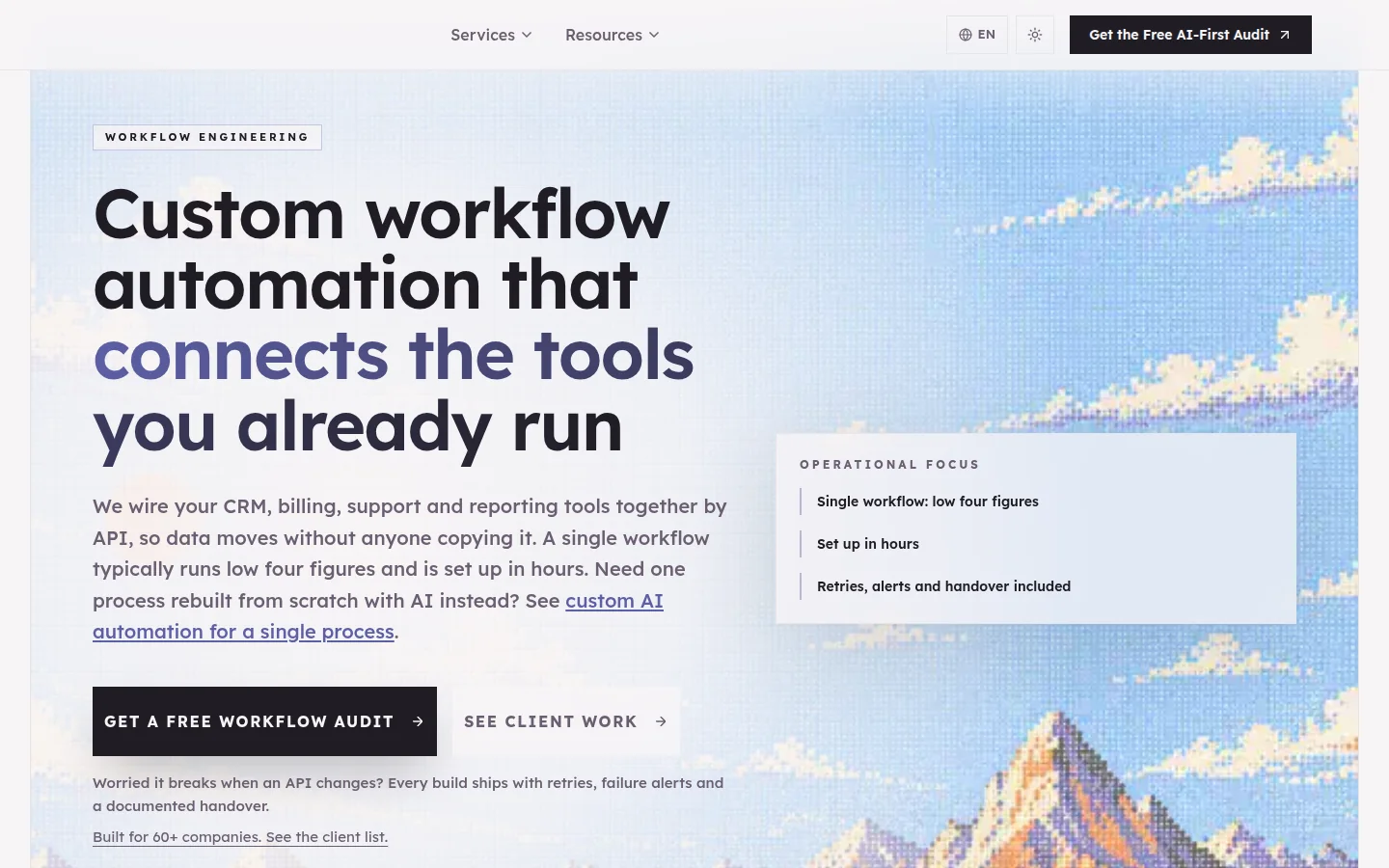
Screenshot of ayautomate.com/services/custom-workflow-automation, taken 2026-11-14.
If you'd rather have someone move your functions for you: AY Automate is an automation service. Its page says it rebuilds existing automations in custom code and that pricing starts at $3K a month. It is a service, not a host, so it isn't ranked or scored above.
How to choose a Deno Deploy alternative
Bar chart of the monthly price of the first paid plan, read on November 11, 2026. Cloudflare Workers Paid costs $5 a month, Railway Hobby $5, Netlify Personal $9 and Supabase Pro $25.
- Cloudflare Workers Paid$5
- Railway Hobby$5
- Netlify Personal$9
- Supabase Pro$25
Source: Cloudflare Workers pricing, Railway pricing, Netlify pricing, Supabase pricing. Checked Nov 11, 2026.
1) Do you want to keep your Deno code as it is?
If yes: Supabase Edge Functions for edge functions, or Railway, Fly.io, Render and Cloud Run for a Deno server in a container. If you can rewrite the handler: Cloudflare Workers, with Deno's migration help if you pay for Deploy.
2) Do you use Deno KV?
Pick by consistency. Strongly consistent: SQLite Durable Objects or D1 on Cloudflare, Postgres on Supabase, or SQLite on a Fly.io or Railway volume. Simple key-value is fine: Netlify Blobs or Workers KV.
3) Do you use Deno.cron?
Cloudflare Workers runs cron every minute and Supabase every second, both on the $0 plan. Railway's cron needs a paid plan after the trial, Render's cron is paid, Fly.io's built-in schedules are hourly, and Bunny has none.
4) Is the app for work or for fun?
Vercel Hobby is non-commercial only. Cloudflare's $0 plan has no such clause and never pauses, and Supabase pauses $0 projects after a week idle. Count the real monthly cost: Cloudflare Workers Paid is $5, Railway Hobby $5, Netlify Personal $9 and Supabase Pro $25.
Get your dev tool into lists like this one

Screenshot of aylistcle.com, taken 2026-11-14.
If you build a developer tool, being named on pages like this one is how developers and AI search find you. AY Listicle puts SaaS products into "best of" listicles that buyers and AI search read, and we check every mention every month. Request a spot on AY Listicle.
FAQ
When does Deno Deploy shut down?
Deno has not stated an exact date. Its October 9, 2026 post says "Deno Deploy will continue operating for six months before shutting down", which points to around April 9, 2027 by our count. Plan to finish your move well before then.
Is Deno shutting down?
No, the Deno runtime continues for now. Deno will ship monthly bug-fix and security releases for another year, then end its own development, and the runtime stays open source. JSR keeps running, with its infrastructure moving to Cloudflare.
What is the best Deno Deploy alternative?
Supabase Edge Functions is the best Deno Deploy alternative if you want to keep your Deno code: it scored 10 of 12 and runs Deno.serve and Deno.env with npm: and jsr: imports. Cloudflare Workers also scored 10, ranks second on our tiebreak, and is where Deno offers migration support to paying customers.
Where should I move Deno KV data?
No vendor imports Deno KV, so you copy the data yourself. For the same strong consistency, use SQLite-backed Durable Objects or D1 on Cloudflare, Postgres on Supabase, or Deno.openKv with a file path on a Fly.io or Railway volume. Workers KV is eventually consistent.
Does Cloudflare have a Deno Deploy migration guide?
Not as of November 11, 2026. No page in Cloudflare's developer docs mentions Deno, and its joint post with Deno says nothing about migrating Deploy apps. Deno's own Wrangler tutorial and its promise of "migration support for paying customers" are what exists.
Which hosts run Deno natively?
Supabase Edge Functions runs a Deno-compatible runtime that takes Deno.serve and Deno.env. Netlify Edge Functions and Bunny Edge Scripting are Deno-based but use their own handlers. Railway, Fly.io, Render and Google Cloud Run run the Deno binary in a container.
Is there a free Deno Deploy alternative?
Yes. Cloudflare Workers includes 100,000 requests a day on its $0 plan, Supabase 500,000 invocations a month and Netlify 300 credits a month. Google Cloud Run includes 2 million requests a month but needs a billing account, and Vercel Hobby is for non-commercial use only.
Can I still sign up for Deno Deploy?
Deno has not said signups are closed. On November 11, 2026, the pricing page still offered "Free $0/month" with "Start free", and the console login said it would create an account on sign-in. With a shutdown months away, start new apps somewhere else.
Sources: Deno is joining Cloudflare, Deno Deploy docs, Deno Deploy pricing, Deno KV on Deploy, Deno Deploy cron, Supabase pricing, Cloudflare Durable Objects pricing, Netlify pricing, Railway cron jobs, Render regions, Vercel pricing, Bunny pricing. All read November 11, 2026.