
Pipedream Workflows stops running on March 31, 2027, and Pipedream deletes all Workflows data, including OAuth tokens, by April 30, 2027. That leaves 140 days from today to rebuild every workflow somewhere else, and new signups are already closed.
Pipedream's draw was code steps in Node.js or Python sitting next to thousands of prebuilt actions, with HTTP, cron, email and app triggers. No single Pipedream alternative matches all of that, and the tool you pick decides how much you rebuild by hand. This page scores 8 of them on six named criteria, with prices, weak spots and a migration plan built on Pipedream's own export.
When Pipedream Workflows shuts down: the dates
Pipedream announced the shutdown on its docs page Workflows and String Are Shutting Down on March 31, 2027. The key lines, quoted exactly:
| What | Pipedream's words |
|---|---|
| Shutdown | "Pipedream Workflows and String will shut down on March 31, 2027." |
| Signups | "we're no longer accepting signups or subscriptions" |
| Data | "All Workflows data will be permanently deleted by April 30, 2027, including the credentials and OAuth tokens for your connected accounts." |
| Export | "an export tool that lets you download the structure of your workflows as JSON, one project at a time" |
| Billing | "All subscriptions will remain active until March 31, 2027. On that date, we'll automatically cancel it and issue a prorated refund" |
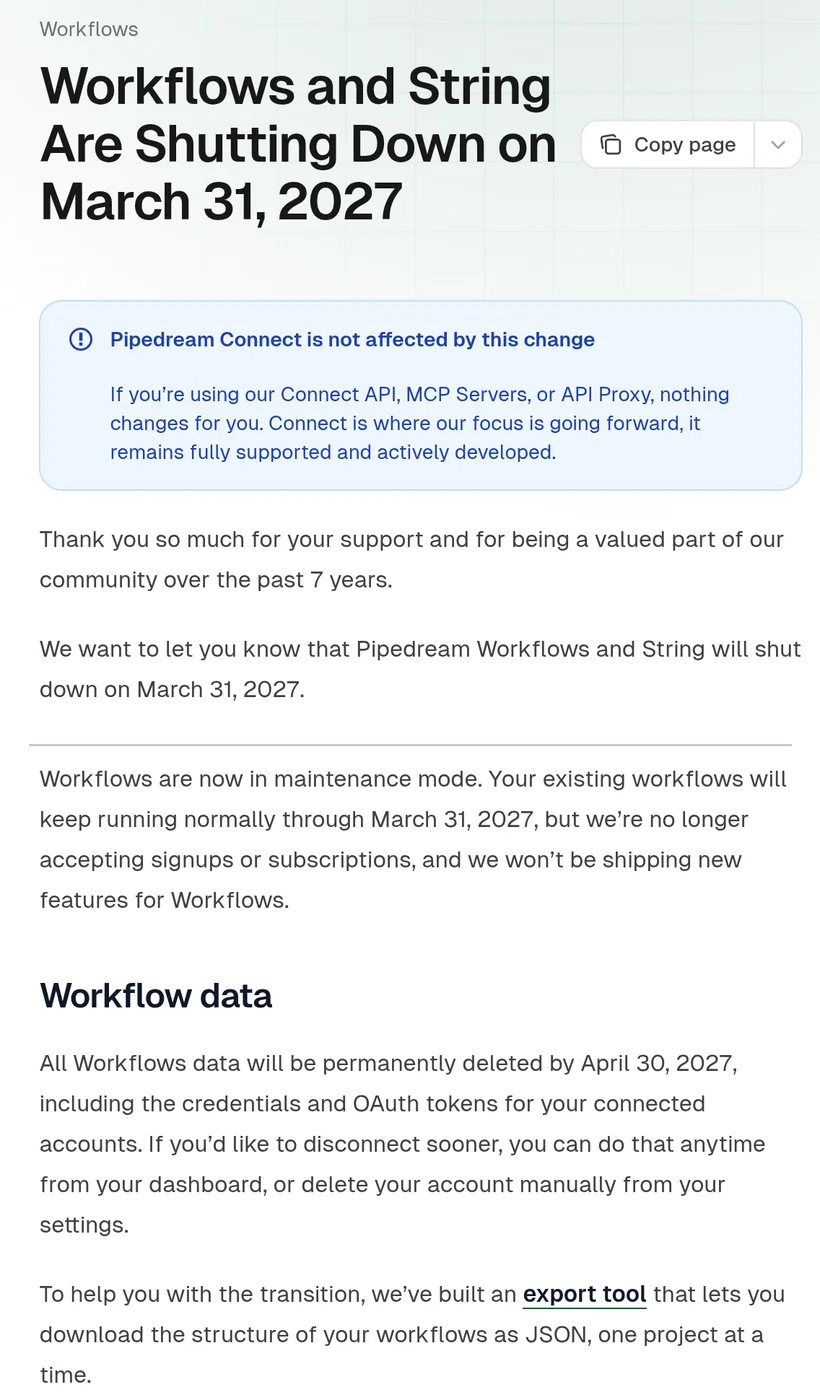
Screenshot of Pipedream's shutdown notice, captured November 11, 2026, cropped to the title, the opening and the data section.
Pipedream Connect is a separate product and stays. Pipedream's pricing docs say: "Pipedream Connect is not affected and remains fully supported." If you only use the Connect API, MCP servers or API Proxy, nothing changes for you, and this page is not for you.
How we ranked these Pipedream alternatives
We scored every entry on the same six criteria, each asking how close a tool comes to what a Pipedream workflow did. Every row links to the vendor page we read on November 11, 2026.
| Criterion | Yes | Partial | No |
|---|---|---|---|
| Code steps | JavaScript or TypeScript and Python steps in the same workflow as prebuilt actions, with npm or PyPI packages | One language only, packages blocked on the hosted plan, or code on paid plans only | No code steps |
| Integrations (where a vendor states two numbers, we use the lower one) | The vendor states 1,000 or more prebuilt app integrations | 100 to 999 | Under 100, or no prebuilt app actions |
| Triggers: Pipedream had HTTP, schedule, email (its own inbound address) and app-event triggers | All four built in | Two or three, for example email only by polling your own IMAP mailbox | One or none |
| Self-hosting | You can self-host at $0 under an OSI open-source license (MIT, Apache-2.0, AGPL) | Self-hosting at $0 under a source-available license, or self-hosting on a paid plan only | Cloud only |
| $0 plan | A hosted $0 plan with no end date that covers one workflow every 15 minutes (about 2,900 runs in 30 days) | A $0 plan with a smaller allowance, a slower schedule or a step cap | A trial only, or none |
| Migration from Pipedream | The vendor publishes a Pipedream migration guide that works from Pipedream's export | No guide, but Node.js or Python code steps paste in with small changes | Neither |
Yes is worth 2 points, Partial 1 and No 0, for a total out of 12. The order of this list follows the totals. Ties go to the higher Code steps score, then the higher Migration score, then the higher $0 plan score, then the alphabet. If one criterion matters more to you, re-rank by that column.
Best Pipedream alternatives: a quick overview
Bar chart of the number of prebuilt integrations each vendor states on its own site, read on 11 November 2026. Zapier 9,000+ apps, Pipedream 3,000+ APIs (shutting down), Make 3,000+ apps, Kestra 2,600+ plugins, Activepieces 775 apps, Windmill 200+ resource types.
- Zapier9,000+ apps
- Pipedream (shutting down)3,000+ APIs
- Make3,000+ apps
- Kestra2,600+ plugins
- Activepieces775 apps
- Windmill200+ resource types
Source: Zapier pricing, Pipedream, Make pricing, Kestra plugins, Activepieces pieces, Windmill integrations. Checked Nov 11, 2026.
If you write code in most of your steps:
- Windmill: best for Pipedream users whose workflows are mostly code steps, with a migration guide built for the export.
- Kestra: best for teams that want an Apache-2.0 orchestrator with 2,600+ plugins and a written Pipedream mapping.
- Trigger.dev: best for developers who want workflows as TypeScript in their own repo, with no step time limit.
If you want a hosted tool with a visual builder:
- Latenode: best for a hosted canvas with JavaScript nodes, npm and all four trigger types on a $0 plan.
- Make: best for no-code teams that need 3,000+ apps and a built-in email trigger.
- Zapier: best for teams whose workflows are mostly app-to-app steps across 9,000+ apps.
If you want to self-host a visual builder:
- Activepieces: best for an MIT-licensed visual builder you can run yourself.
- n8n: best for self-hosters who want JavaScript and Python Code nodes with npm modules turned on.
Scores as of November 11, 2026. Pipedream Workflows itself, for reference: Node.js, Python, Go and Bash steps, "3,000+ APIs", HTTP, schedule, email, RSS and app triggers, cloud only.
| Tool | Score (of 12) | Code steps | Integrations | Triggers | Self-hosting | $0 plan | Migration | Source |
|---|---|---|---|---|---|---|---|---|
| Windmill | 10 | Yes TypeScript, Python, Go, Bash, packages from imports | Partial 200+ resource types | Yes HTTP, schedule, email, polling triggers | Yes AGPLv3 core | Partial 1,000 executions a month | Yes guide that reads the export | Windmill Pipedream guide |
| Kestra | 9 | Yes Node.js, Python, Bash, Go script tasks | Yes 2,600+ plugins | Partial email by IMAP or POP3 polling | Yes Apache-2.0 | No 14-day Cloud trial | Yes guide and Copilot from the export | Kestra Pipedream guide |
| Latenode | 8 | Partial JavaScript only, npm allowed | Partial 814 apps | Yes webhook, schedule, mailhook, app triggers | No cloud only | Yes 10,000 CPU seconds a month | Yes paste the export into Copilot | Latenode pricing |
| Trigger.dev | 7 | Yes TypeScript, Python via extension, any npm | No no prebuilt app actions | Partial no email trigger | Yes Apache-2.0 | Partial $5 credits, hourly schedules | Partial no guide, Node.js code | Trigger.dev pricing |
| Activepieces | 7 | Partial TypeScript only, no npm on Cloud | Partial 775 apps | Partial email by IMAP polling | Yes MIT core | Partial 1,000 credits | Partial blog posts only, TypeScript code | Activepieces pricing |
| Make | 7 | Partial JS and Python on paid plans only | Yes 3,000+ apps | Yes webhook, schedule, mailhook, app triggers | No cloud only | Partial 1,000 credits, every 15 min | Partial no guide, Make Code app | Make pricing |
| Zapier | 7 | Partial JS and Python, packages paid only | Yes 9,000+ apps | Yes webhook, schedule, email, app triggers | No cloud only | Partial 100 tasks, two-step Zaps | Partial no guide, Code by Zapier | Zapier pricing |
| n8n | 5 | Partial JS and Python, no npm on Cloud | Partial "500+ native integrations" | Partial email by IMAP polling | Partial Sustainable Use License | No Cloud is a trial | Partial no guide, Code node | n8n pricing |
1. Windmill, Best for workflows that are mostly code steps
- Score
- 10/12
- $0 plan
- Partial1,000 executions a month
Windmill is an open-source developer platform for scripts, flows and apps, where each step is a script in TypeScript, Python, Go, Bash or one of 20+ other languages. Its Pipedream comparison says "Code steps can be TypeScript, Python, Go and Bash, like on Pipedream", which makes it the closest match on this list for a code-heavy workflow.

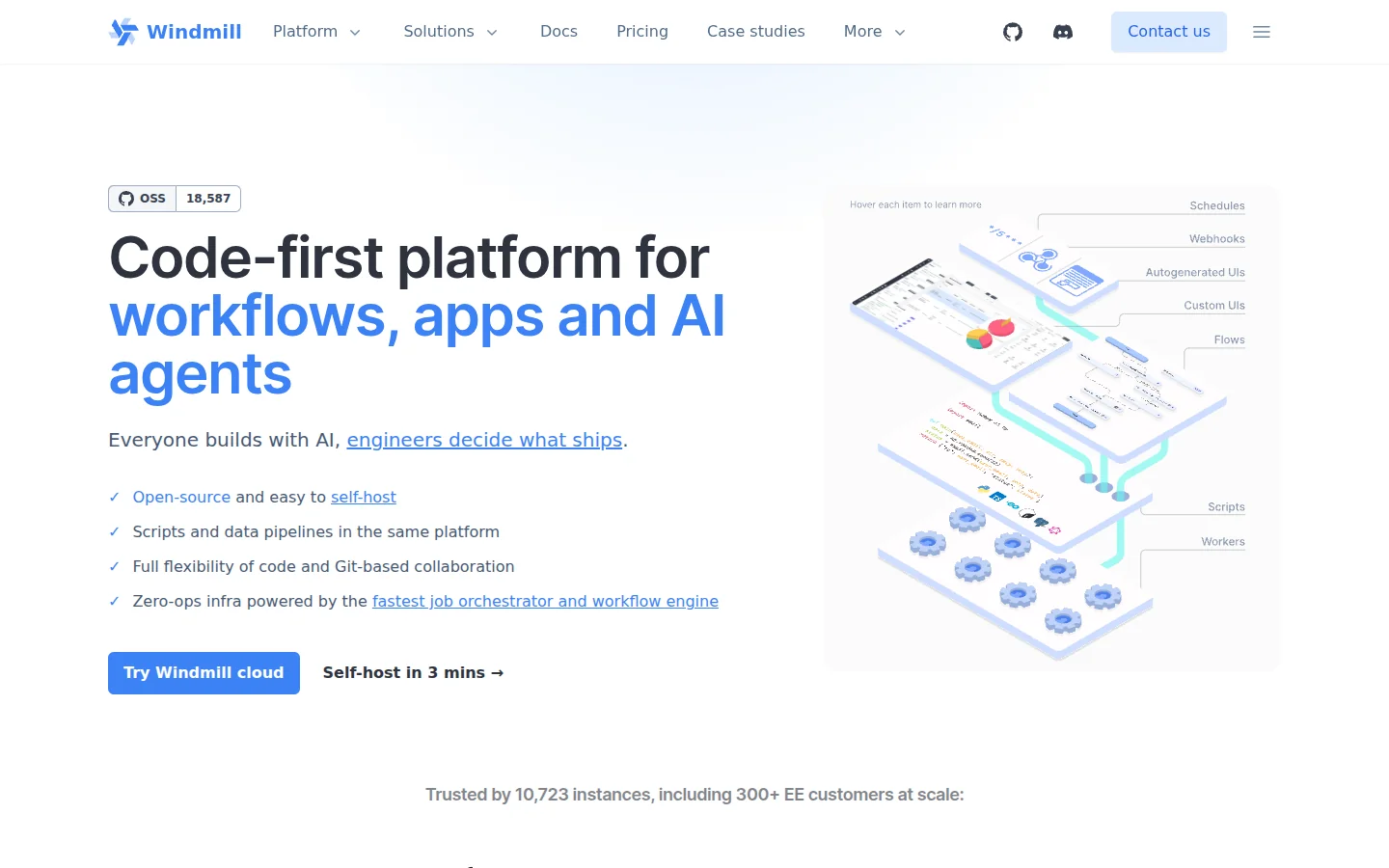
Screenshot of windmill.dev, taken 2026-11-14.
Windmill also publishes a Pipedream migration guide. Your AI coding agent (Claude Code, Codex or Cursor) reads Pipedream's export and rebuilds each workflow as a Windmill flow. Code steps become scripts in the same language, and schedules arrive disabled so the copy doesn't run next to Pipedream.
Key features
- Packages resolve from your import lines, with no package.json or requirements.txt to manage
- Triggers for schedules, webhooks, email, HTTP routes, Kafka, Postgres and more
- Email triggers, unlimited on the Cloud Free plan
- Web IDE, CLI and Git sync
Best for
- Pipedream users whose workflows are mostly Node.js or Python code steps
- Teams that want to self-host under an open-source license
Pricing Cloud Free is $0 with 1,000 executions a month, where an execution is up to one second of compute. Team starts at $10 a month per seat with 10,000 executions per seat. Self-hosting is free with unlimited executions, up to 3 workspaces and 50 users (as of November 2026, Windmill pricing).
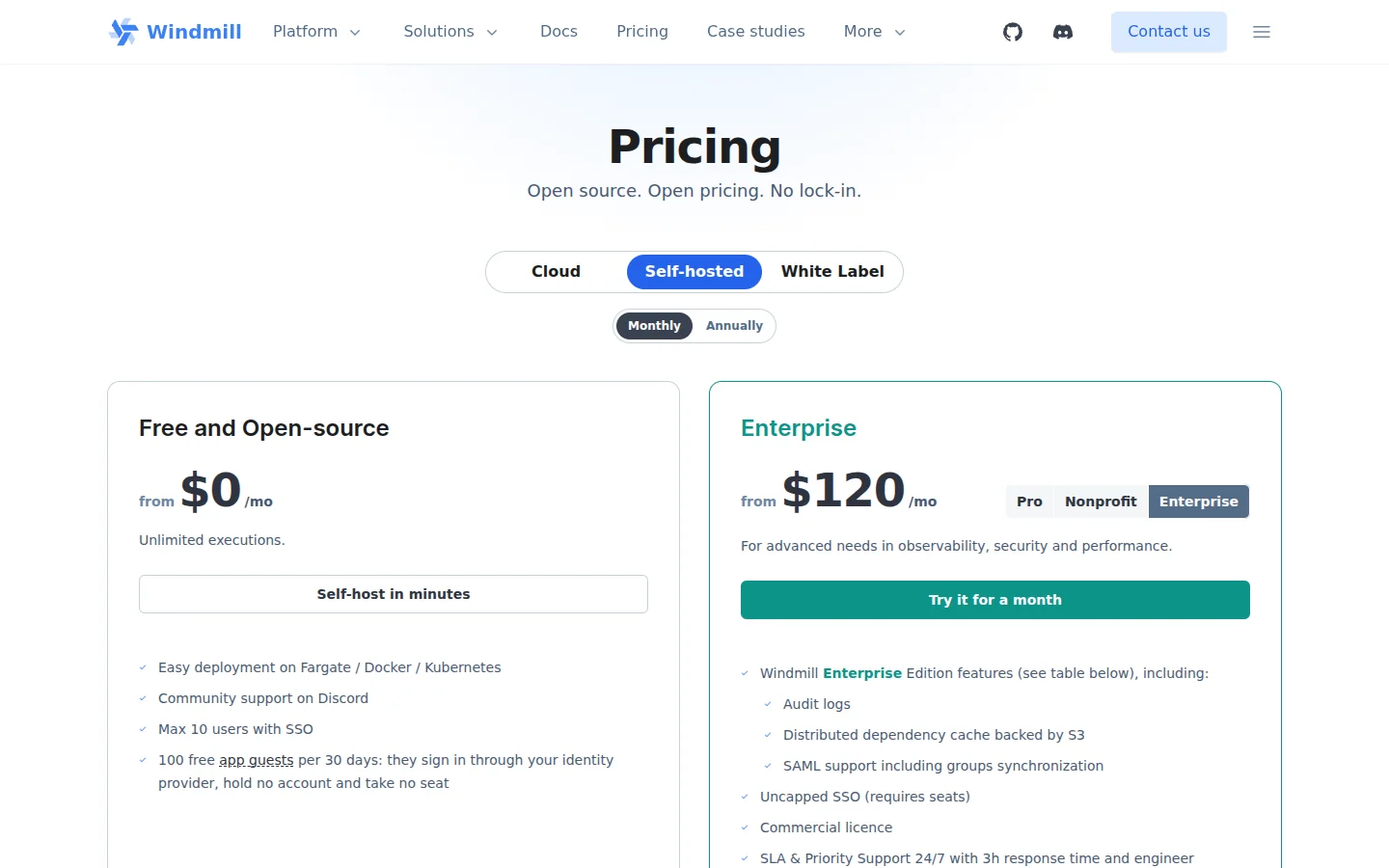
Screenshot of windmill.dev/pricing, taken 2026-11-14.
Pros
- Steps in all four of Pipedream's languages, in a step-by-step flow
- A migration guide built around the export ZIP and its
manifest.json
Cons
- 200+ resource types. Windmill's own Pipedream page answers "Does Windmill have as many integrations as Pipedream?" with "No."
- 1,000 executions a month on Cloud Free won't cover one workflow every 15 minutes
- The guide's CLI commands install the latest version unpinned, so pin a version before you run them
2. Kestra, Best for an Apache-2.0 orchestrator with a large plugin library
- Score
- 9/12
- $0 plan
- No14-day Cloud trial
Kestra is an open-source workflow orchestration platform where flows are YAML files and code runs in script tasks for Node.js, Python, Bash and Go. It lists "2,600+ plugins" on its plugins page, the largest library here among the open-source tools.

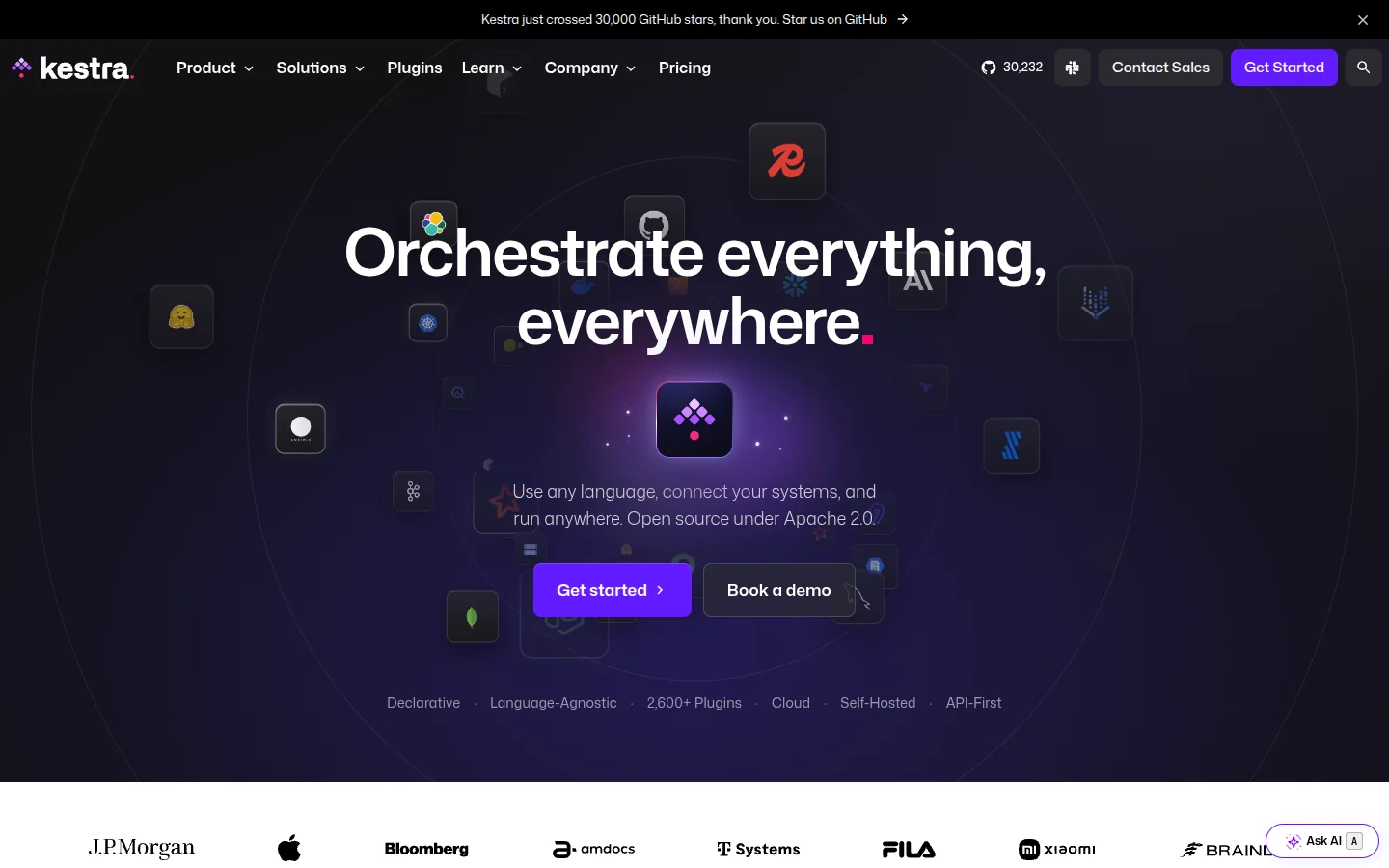
Screenshot of kestra.io, taken 2026-11-14.
Kestra's Pipedream migration guide maps each Pipedream concept to a Kestra flow. It says "Node.js, Python and Bash steps copy into script tasks; what changes is how they read their input and return their results." You give one workflow's JSON to the AI Copilot, review the YAML it proposes, re-create the secrets and run it next to the original.
Key features
- Node.js script tasks install npm packages in
beforeCommands, Python tasks listdependencies - Webhook trigger, cron schedule with an optional seconds field, and plugin or polling triggers
- Email by polling an IMAP or POP3 mailbox
- Flows in YAML, so they live in Git
Best for
- Data and platform teams that already keep pipelines in Git
- Teams that want an Apache-2.0 license with no fair-code limits
Pricing The open-source edition is free with unlimited flows and executions. Kestra Cloud offers a 14-day trial with no credit card, and the pricing page does not state Cloud or Enterprise prices (as of November 2026, Kestra pricing).
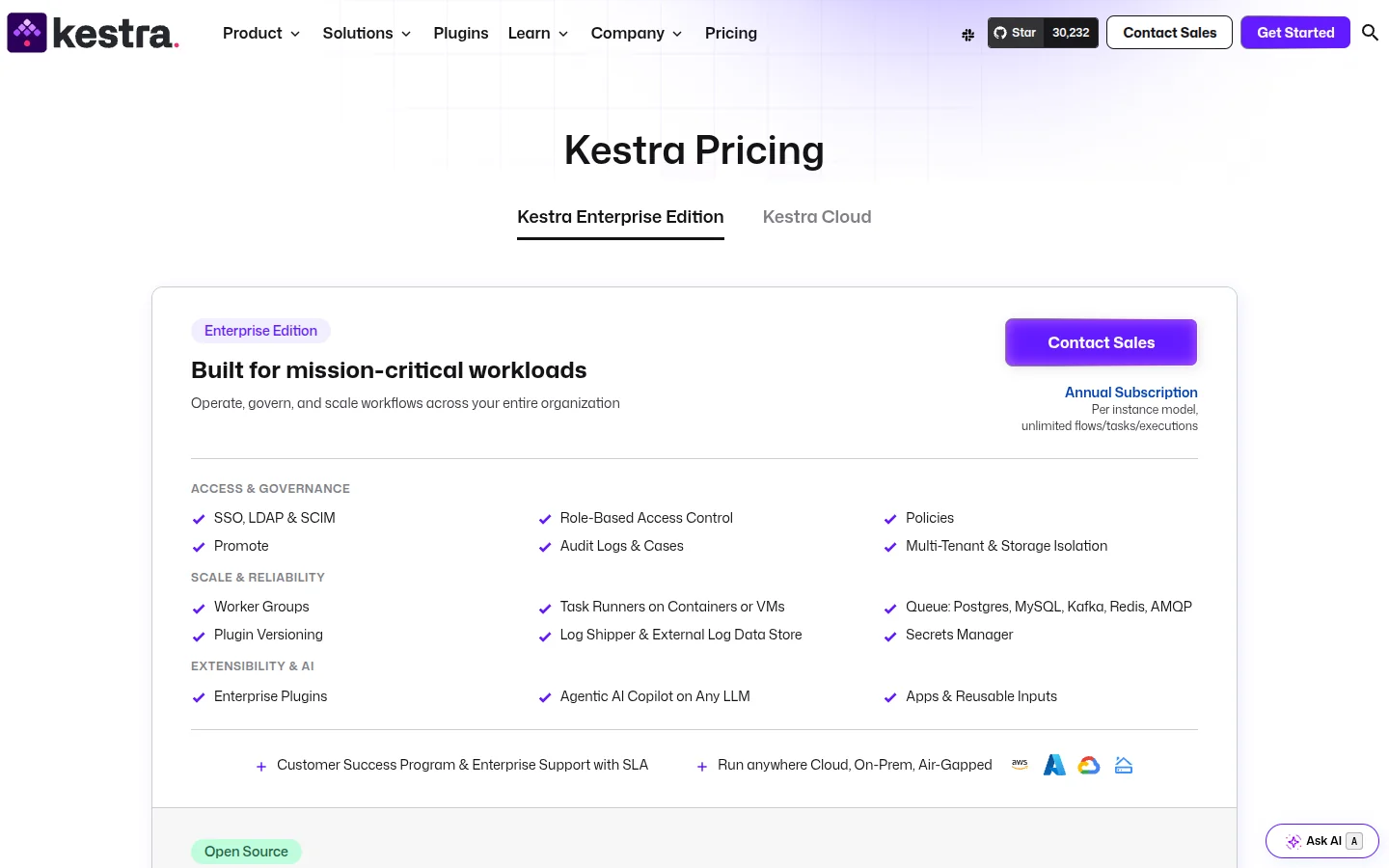
Screenshot of kestra.io/pricing, taken 2026-11-14.
Pros
- Apache-2.0 for the whole open-source edition
- A step-by-step mapping from Pipedream concepts to Kestra tasks
Cons
- No $0 hosted plan, so you self-host or pay for Cloud at a price not stated
- YAML flows, not a step-by-step visual builder like Pipedream's
- No hosted inbound email address. The open-source edition has no secret store, per Kestra's secrets docs.
3. Latenode, Best for a hosted canvas with JavaScript nodes and all four triggers
- Score
- 8/12
- $0 plan
- Yes10,000 CPU seconds a month
Latenode is a hosted AI workflow automation platform with a drag-and-drop canvas and a JavaScript node that imports npm packages. It is the only hosted tool here with webhook, schedule, inbound email and app triggers on a $0 plan that covers a workflow every 15 minutes.
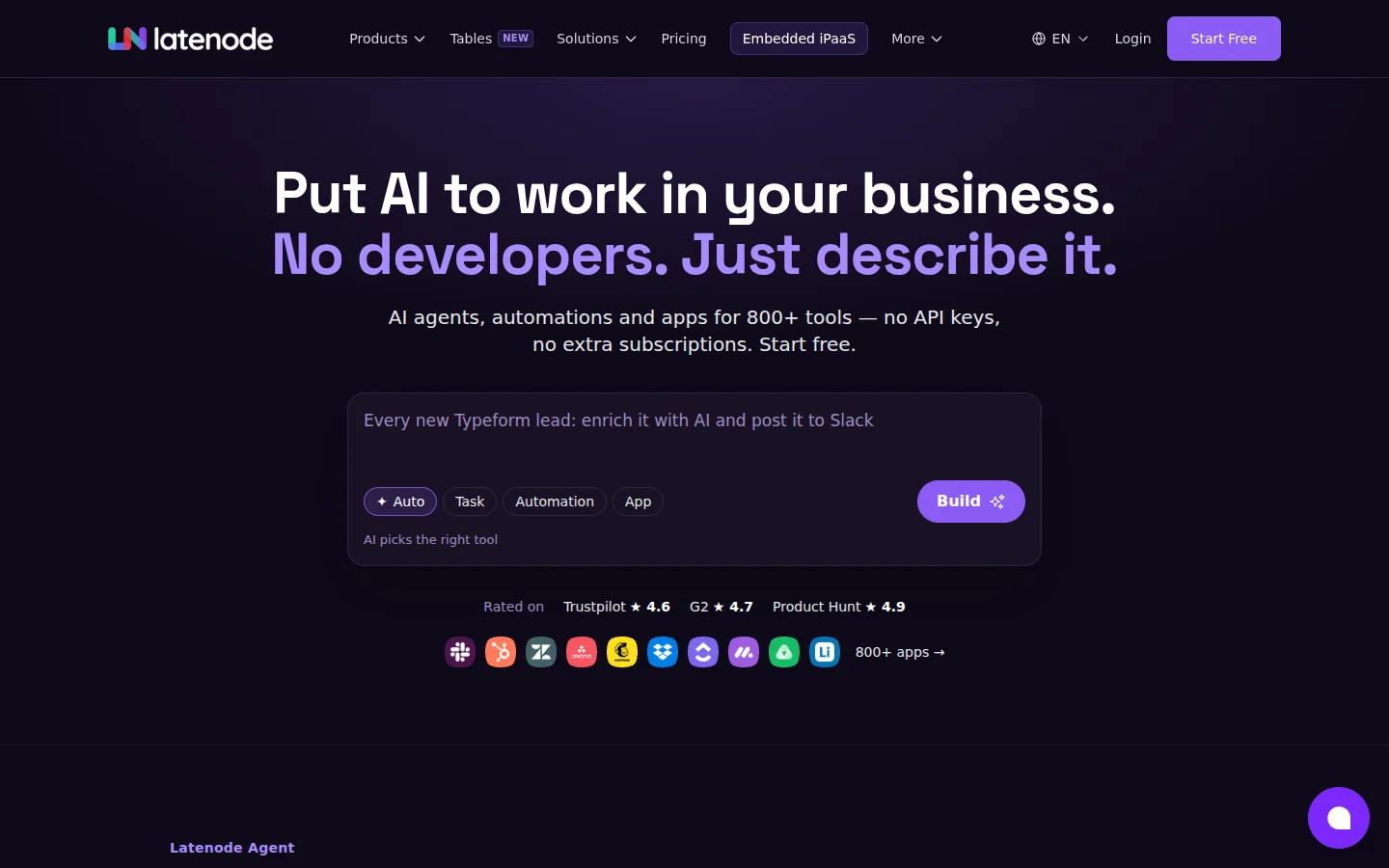
Screenshot of latenode.com, taken 2026-11-14.
Latenode's Pipedream alternative page tells you to "Export it, paste the JSON into AI Copilot, review the plan, then test and deploy." Python, Go and Bash steps don't run as is: the page says the code node's assistant "writes the Node.js version of a Python, Go or Bash step for you to review."
Key features
- JavaScript node with npm imports, on Node.js or Bun
- Mailhook: a unique email address that starts a scenario
- Cron schedules and app triggers, polled every 10 minutes on Free
- 814 apps, with 5,548 actions behind one MCP endpoint, per latenode.com
Best for
- Pipedream users with JavaScript steps who want a hosted tool and no servers
- Small workflows that run often but finish in a second or two
Pricing Free is $0 a month with 10,000 CPU seconds, 5 active workflows and a 3-minute run limit. Pay as you go has no base fee and charges $0.00012 per CPU second after the first 10,000 (as of November 2026, Latenode pricing).
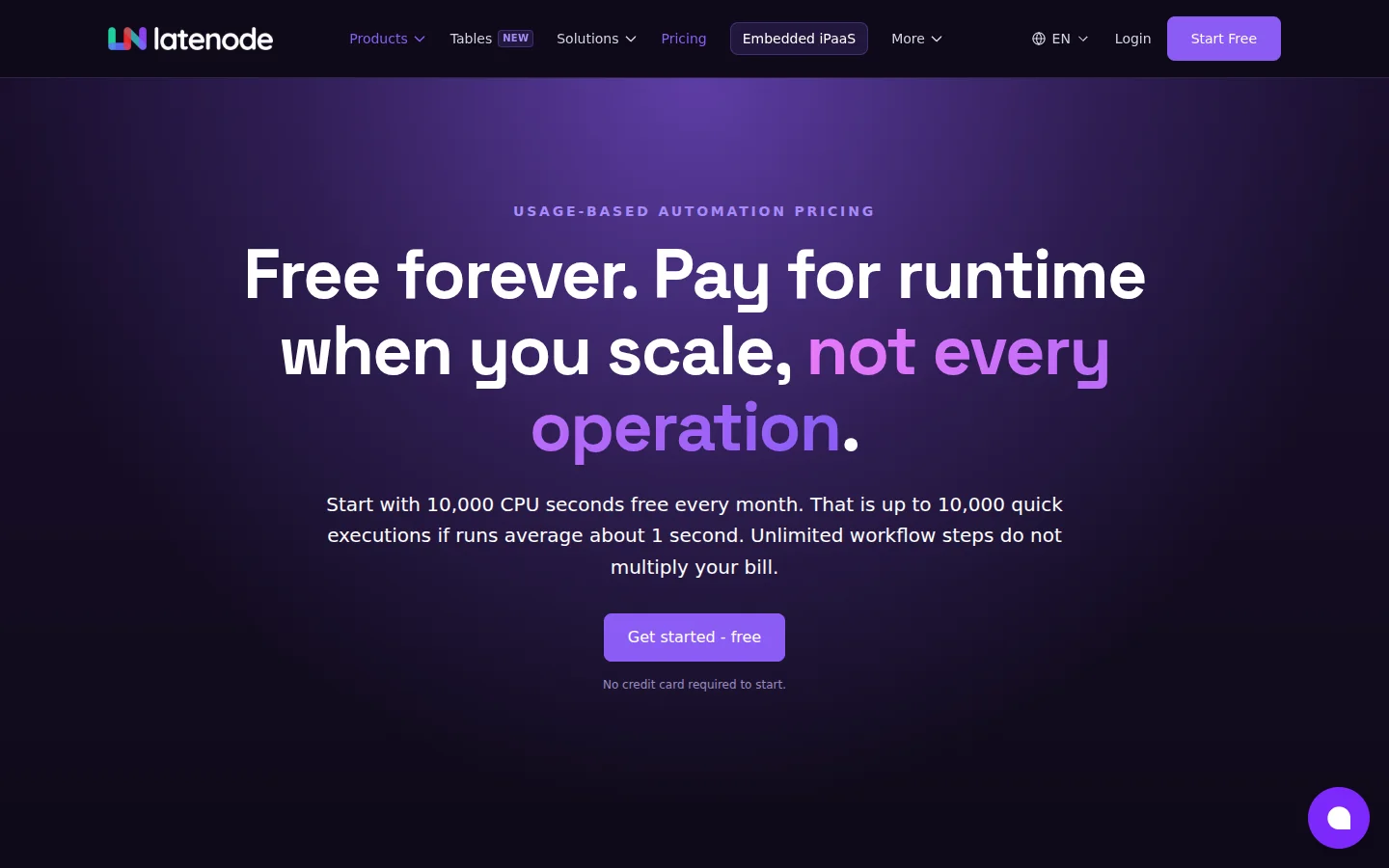
Screenshot of latenode.com/pricing-plans, taken 2026-11-14.
Pros
- All four Pipedream trigger types on the $0 plan
- Billing by CPU time, not by step
Cons
- JavaScript only. Python steps need rewriting.
- Cloud only, and Latenode says so on its own Pipedream page
- 5 active workflows on Free, and the "5,500+ integrations" on its homepage counts actions, not apps
4. Trigger.dev, Best for workflows as TypeScript in your own repo
- Score
- 7/12
- $0 plan
- Partial$5 credits, hourly schedules
Trigger.dev is an open-source background jobs platform where you write tasks in TypeScript in your own codebase and it runs them with retries, queues and cron schedules. There's no execution timeout, per Trigger.dev's docs.

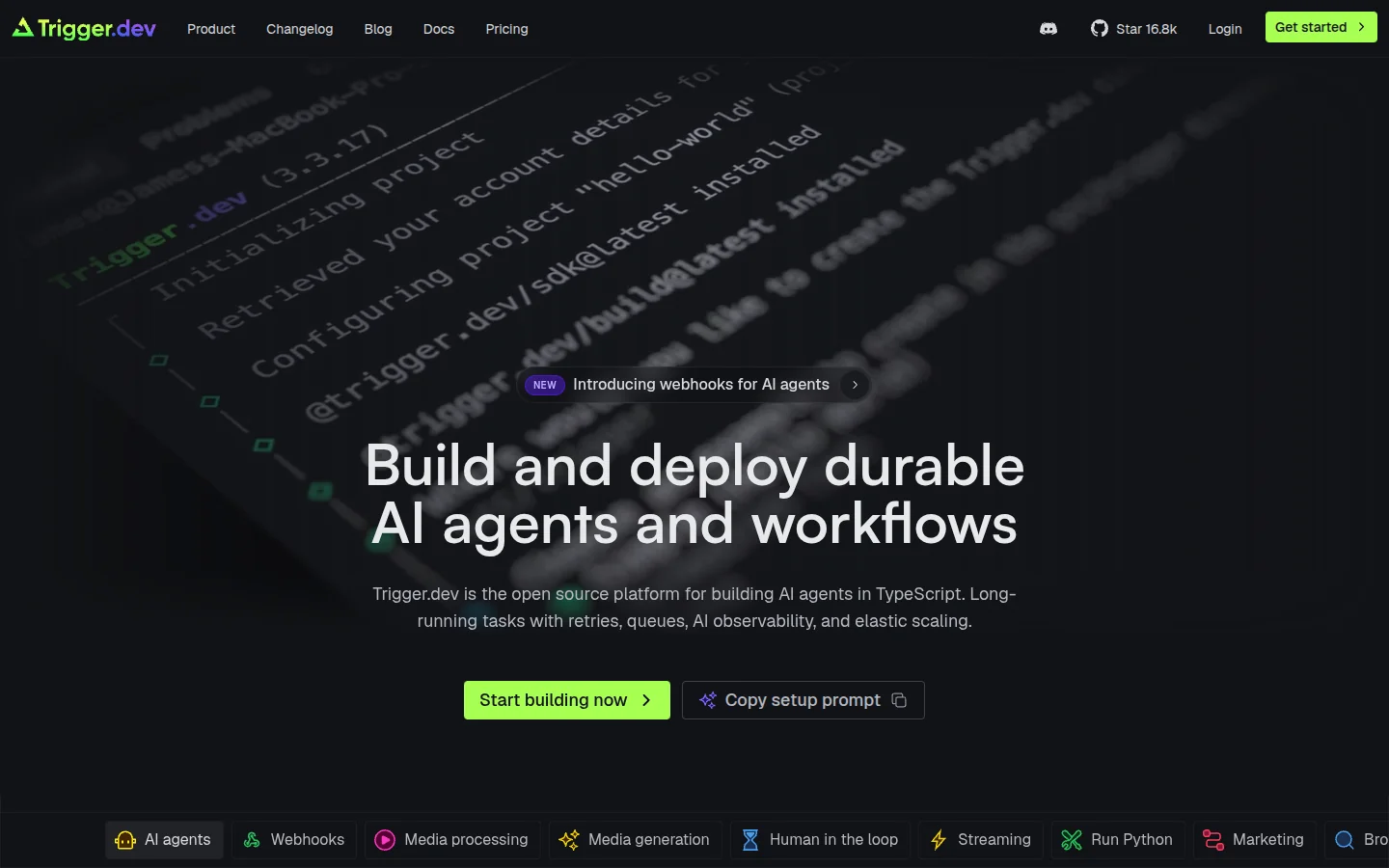
Screenshot of trigger.dev, taken 2026-11-14.
It suits Pipedream users who wrote most of the logic themselves and want it in Git. It does not replace prebuilt actions: there is no app action library, only inbound webhooks from 48 services on its webhook integrations page.
Key features
- Tasks in TypeScript, any npm package, and Python through
@trigger.dev/python - Cron schedules and hosted webhook endpoints that verify each request
- No maximum run duration
- Apache-2.0 core, MIT SDK, self-hostable
Best for
- Developers whose Pipedream steps were mostly custom Node.js code
- Jobs that run for minutes or hours
Pricing Free is $0 with $5 of credits a month and 10 schedules. Hobby is $10 a month with $10 of credits and 100 schedules, and Pro is $50 a month (as of November 2026, Trigger.dev pricing).
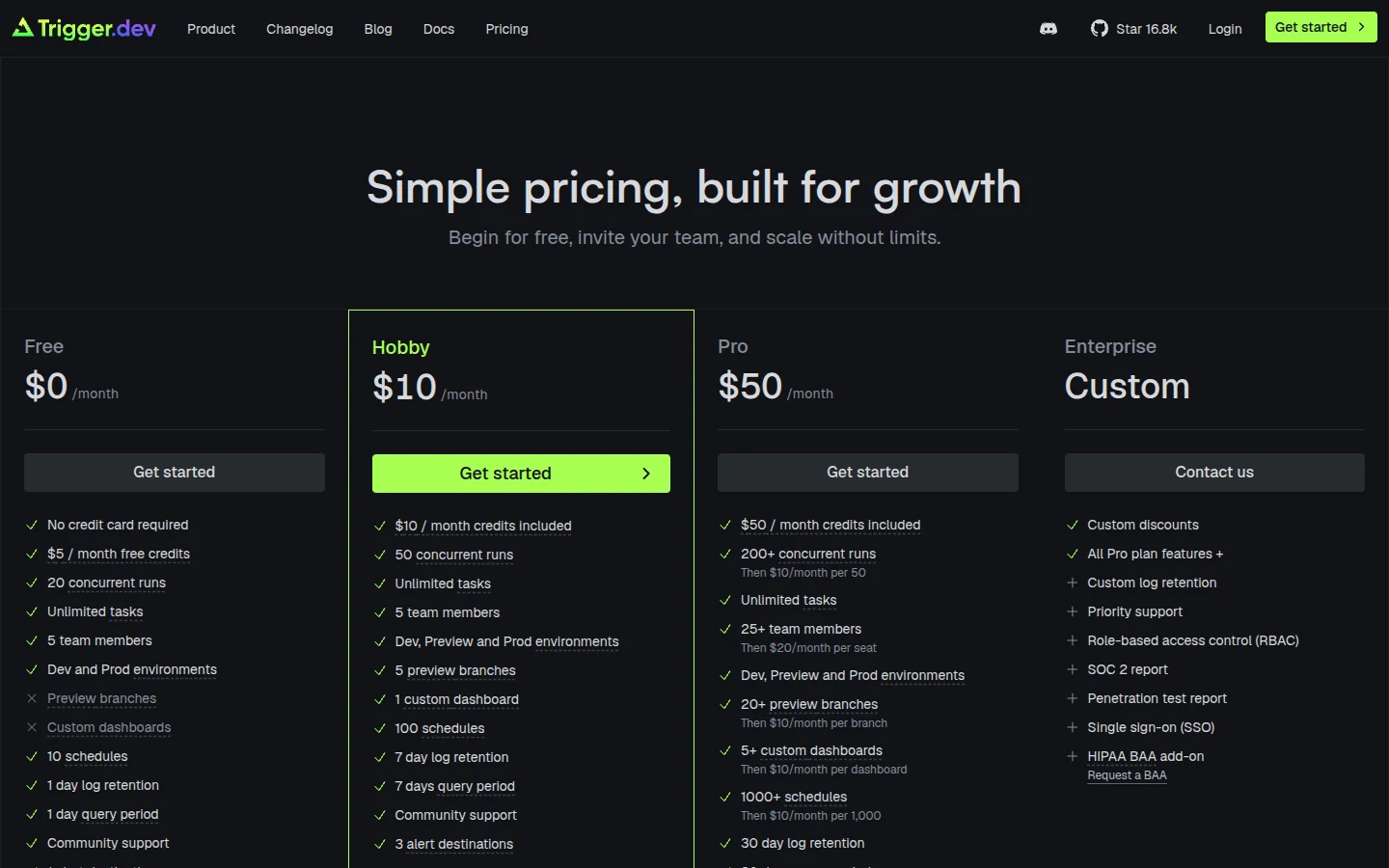
Screenshot of trigger.dev/pricing, taken 2026-11-14.
Pros
- Permissive open-source license and no step time limit
- Your workflows become plain code you can test and review
Cons
- Free schedules run "no more than once per hour", per Trigger.dev's scheduled tasks docs
- No prebuilt app actions and no email trigger
- Every step needs rewriting as an SDK task
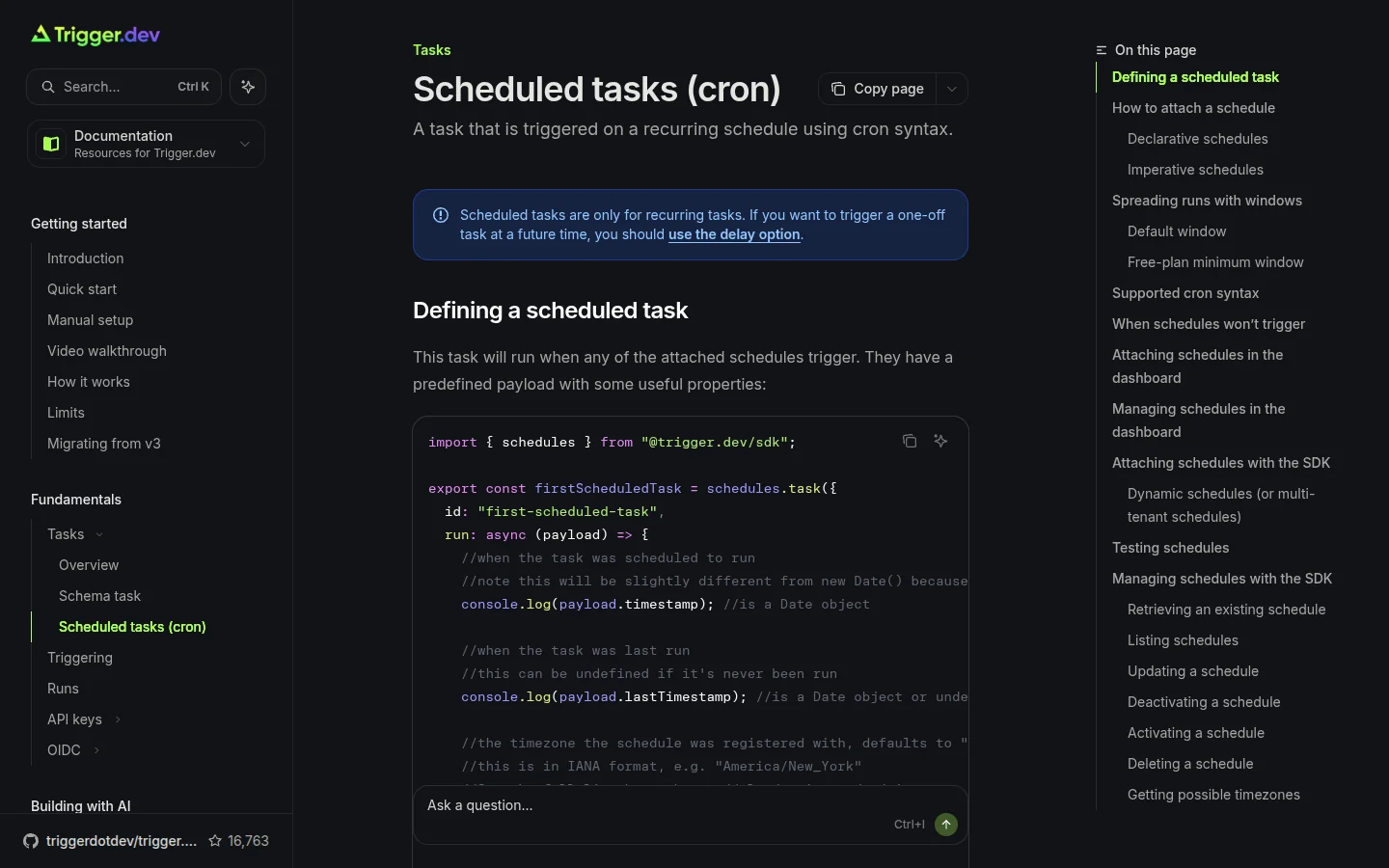
Screenshot of trigger.dev/docs/tasks/scheduled, taken 2026-11-14.
5. Activepieces, Best for an MIT-licensed visual builder you can run yourself
- Score
- 7/12
- $0 plan
- Partial1,000 credits
Activepieces is an open-source automation platform with a visual flow builder, 775 app integrations it calls pieces, and inline TypeScript code steps. Its core is MIT licensed, per its license page, and every plan, Free included, can run on Cloud or on-prem.

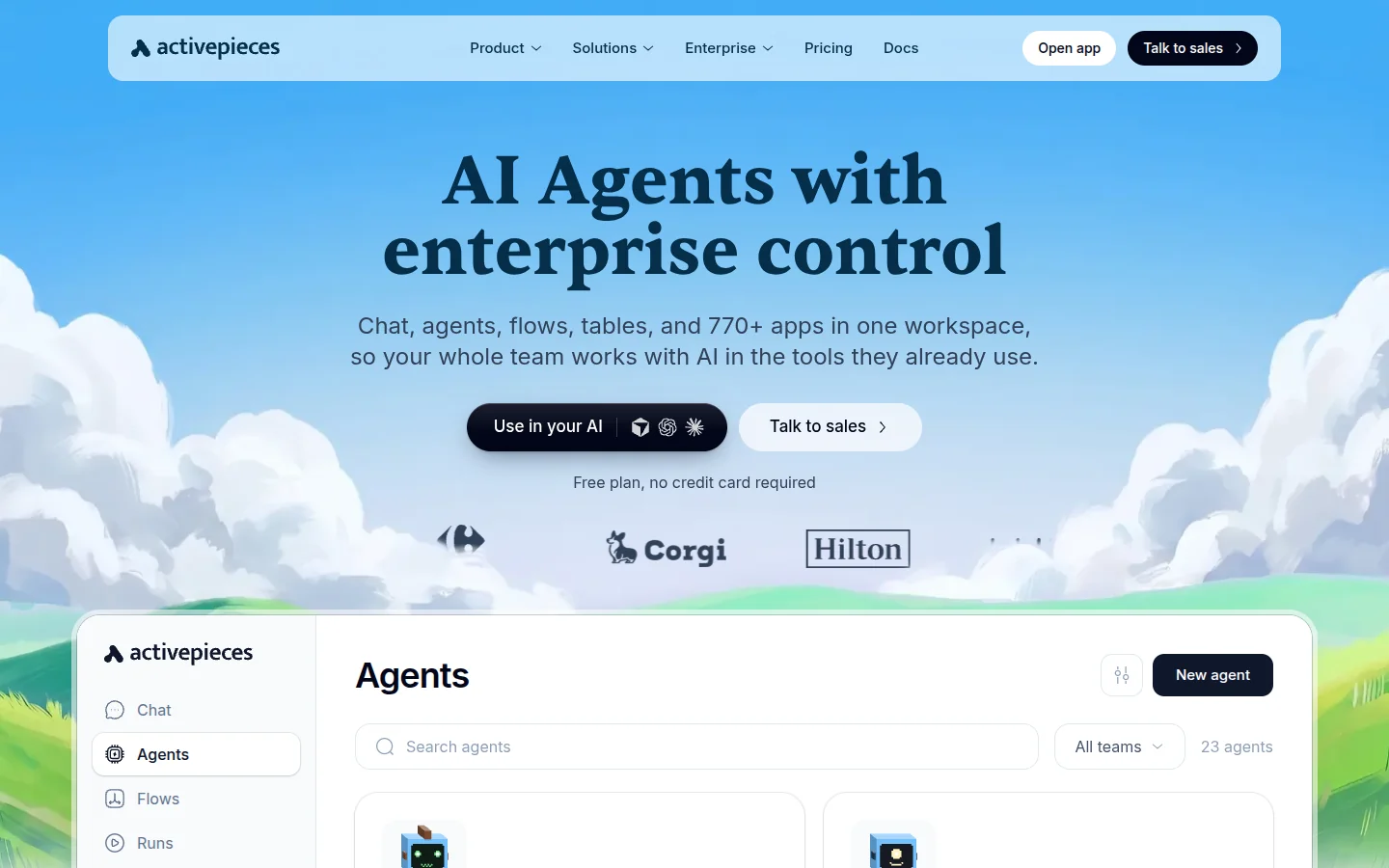
Screenshot of activepieces.com, taken 2026-11-14.
The code step is the weak spot for Pipedream users. Activepieces Cloud runs code in a fresh V8 isolate with "no require, no filesystem, no npm", per its sandboxing docs. Self-hosting can allow npm in a more privileged mode.
Key features
- Inline TypeScript code steps next to visual steps
- Webhook and schedule triggers, with cron expressions
- App triggers that are instant or polled every 5 minutes
- Email by IMAP polling
Best for
- Ops teams who build visually and write a few lines of TypeScript
- Teams that want to self-host an MIT-licensed tool
Pricing Free is $0 with 1,000 credits and up to 5 users. Plus is $20 a month flat with 10,000 credits, then $0.007 a credit. A run is one credit however many steps it has (as of November 2026, Activepieces pricing). The page also lists Free's credit reset as "Daily", so check the allowance in your account.
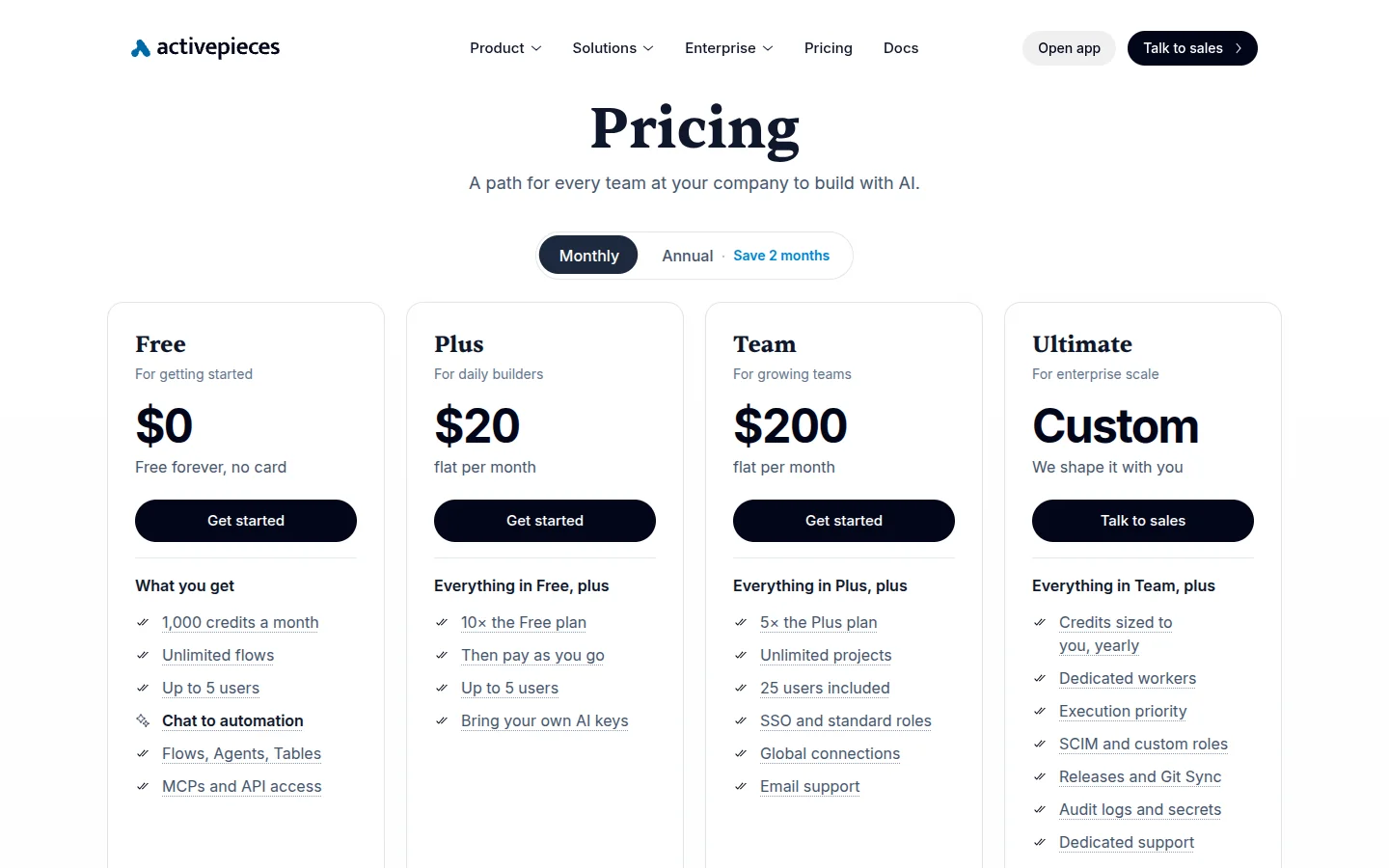
Screenshot of activepieces.com/pricing, taken 2026-11-14.
Pros
- One credit per run, whatever the step count
- Same pieces on Cloud and self-hosted
Cons
- TypeScript only, and no npm packages on Cloud
- No hosted inbound email address
- No Pipedream guide or importer, only blog posts
6. Make, Best for no-code teams that need many apps and a mailhook
- Score
- 7/12
- $0 plan
- Partial1,000 credits, every 15 min
Make is a hosted visual automation platform where workflows are called scenarios, with "3,000+ native apps" in the footer of its pricing page. It has every Pipedream trigger type: webhooks, schedules, a custom mailhook address and instant or polling app triggers.

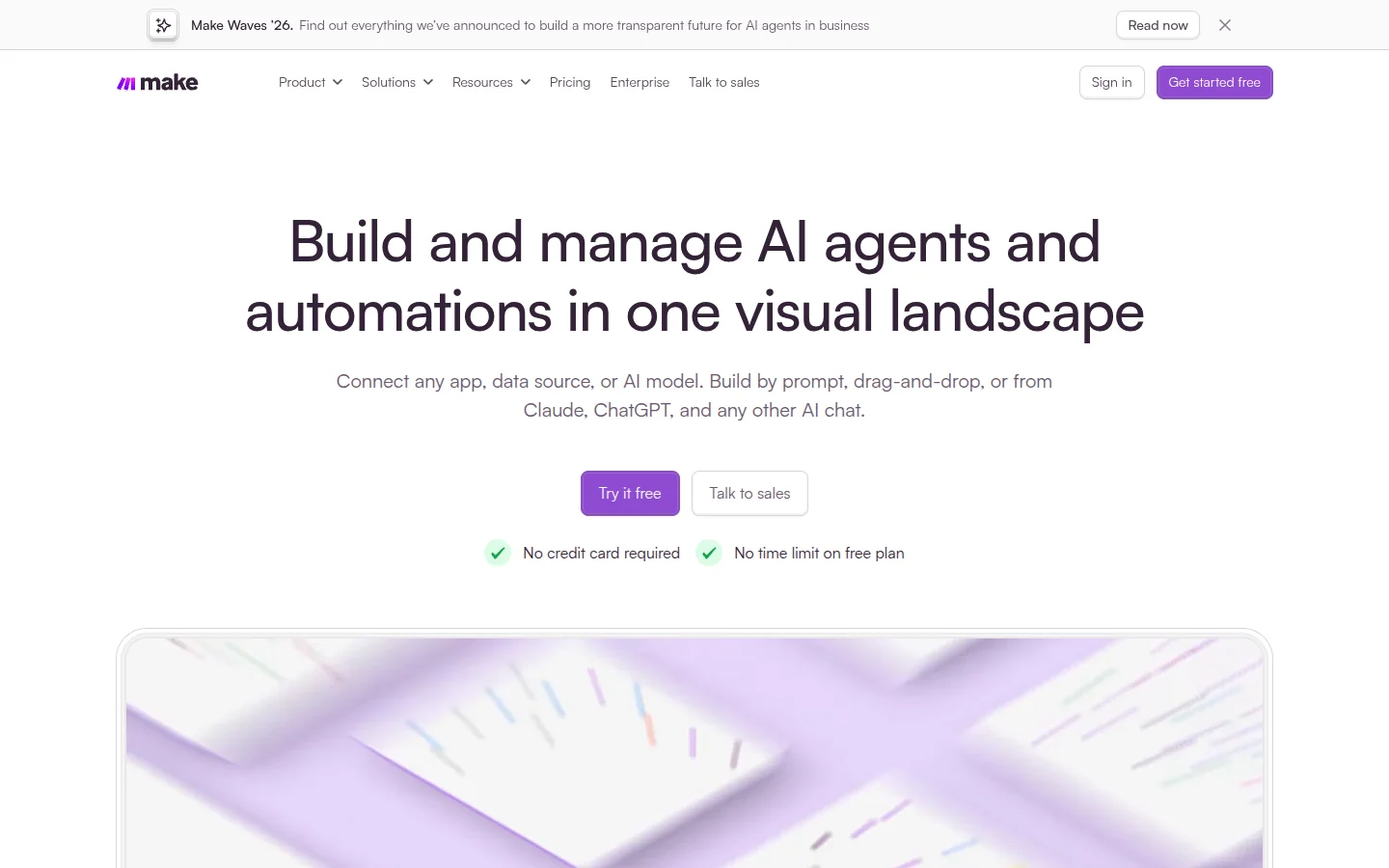
Screenshot of make.com, taken 2026-11-14.
Code is where it falls short for Pipedream users. The Make Code app runs JavaScript or Python, but it is in open beta on paid plans only. Custom libraries are Enterprise only, and code costs "two credits for every one second of code execution time."
Key features
- Custom webhooks and a mailhook address with a 25 MB limit
- Instant triggers from app webhooks, or scheduled polling
- Make Code for JavaScript (Node 20) and Python 3.12
- Scenario blueprints export and import as JSON
Best for
- Teams whose workflows are mostly prebuilt app steps with little code
- No-code builders who want an email trigger without running a mail server
Pricing Free is $0 with 1,000 credits a month and a 15-minute minimum interval between runs. Core adds unlimited active scenarios and schedules down to the minute (as of November 2026, Make pricing). Make fills in plan prices with a script, and the page text we could read did not include them, so the Core price is not stated here.
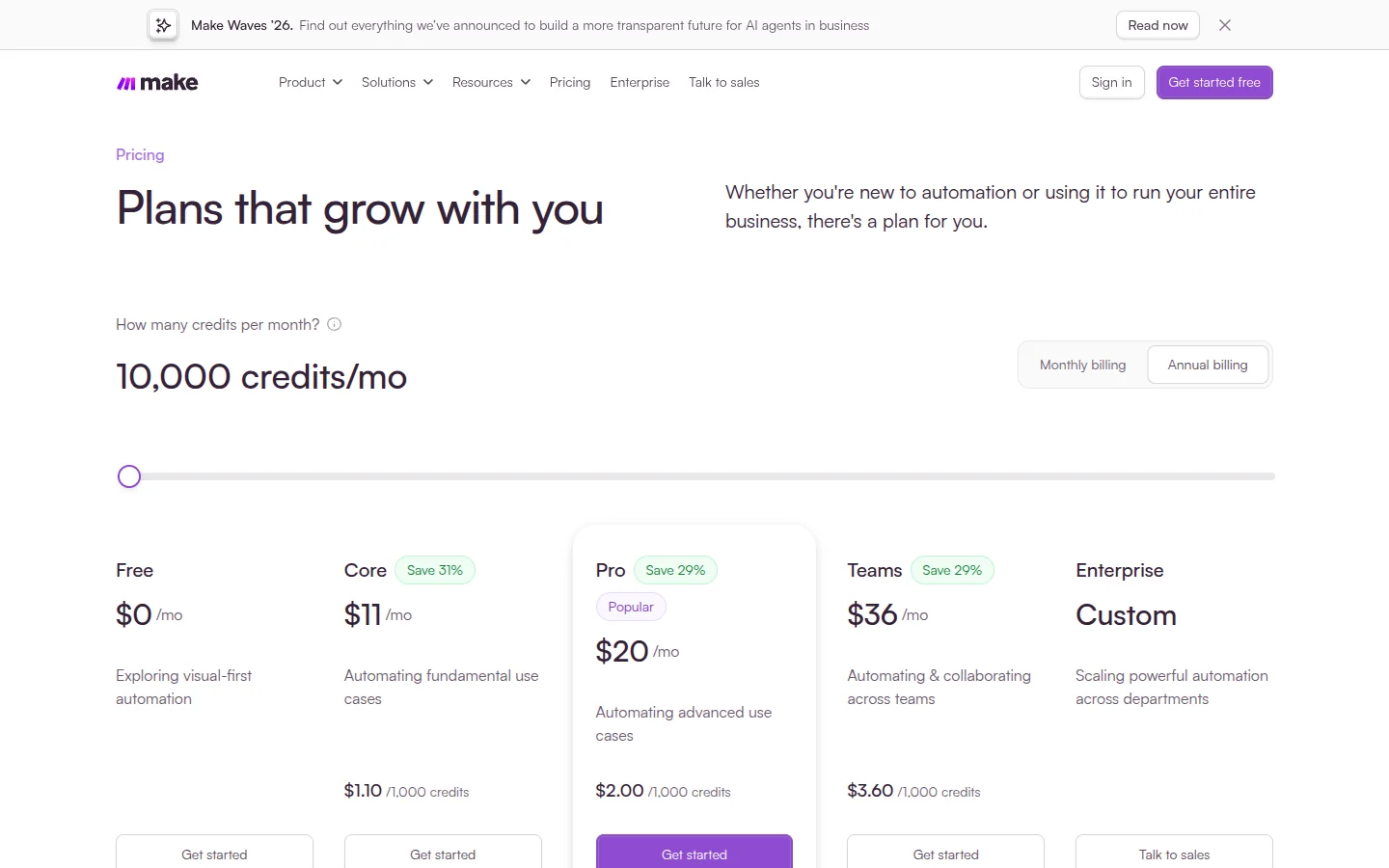
Screenshot of make.com/en/pricing, taken 2026-11-14.
Pros
- All four Pipedream trigger types
- A large app library with instant triggers
Cons
- No code steps on the $0 plan, and no npm or PyPI packages below Enterprise
- Cloud only
- No Pipedream guide. Its JSON import reads Make blueprints only.
7. Zapier, Best for workflows that are mostly app-to-app steps
- Score
- 7/12
- $0 plan
- Partial100 tasks, two-step Zaps
Zapier is a hosted automation platform with "9,000+ apps", the largest library on this list, per Zapier pricing. Code by Zapier runs JavaScript (Node.js 22) or Python 3.13 as a step, and it works on the Free plan.

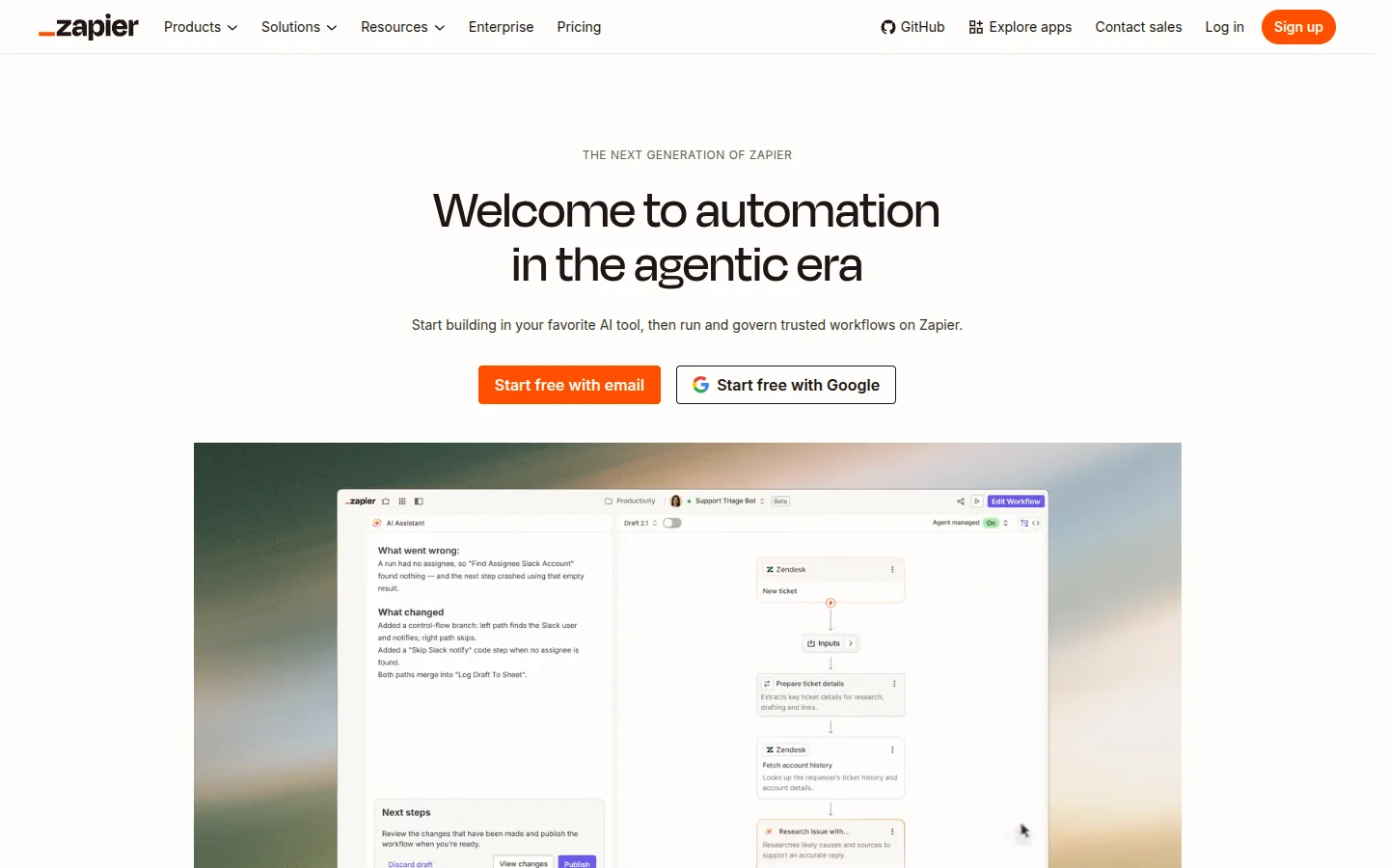
Screenshot of zapier.com, taken 2026-11-14.
The limits sit around the code. Free code steps get 1 second of runtime, and packages need "a paid Zapier account", per Zapier's help center. Free Zaps have two steps, so a code step is the single action after the trigger.
Key features
- Code by Zapier in JavaScript or Python, as a trigger or an action
- Email by Zapier with its own @zapiermail.com address
- Webhooks by Zapier and Schedule by Zapier (hourly at most)
- App triggers polled every 15 minutes on Free, 2 minutes on Professional
Best for
- Teams whose Pipedream workflows mostly moved data between SaaS apps
- Non-developers who will take over the workflows after the move
Pricing Free is $0 with 100 tasks a month and two-step Zaps. Professional starts at $19.99 a month billed yearly, with multi-step Zaps and webhooks (as of November 2026, Zapier pricing).
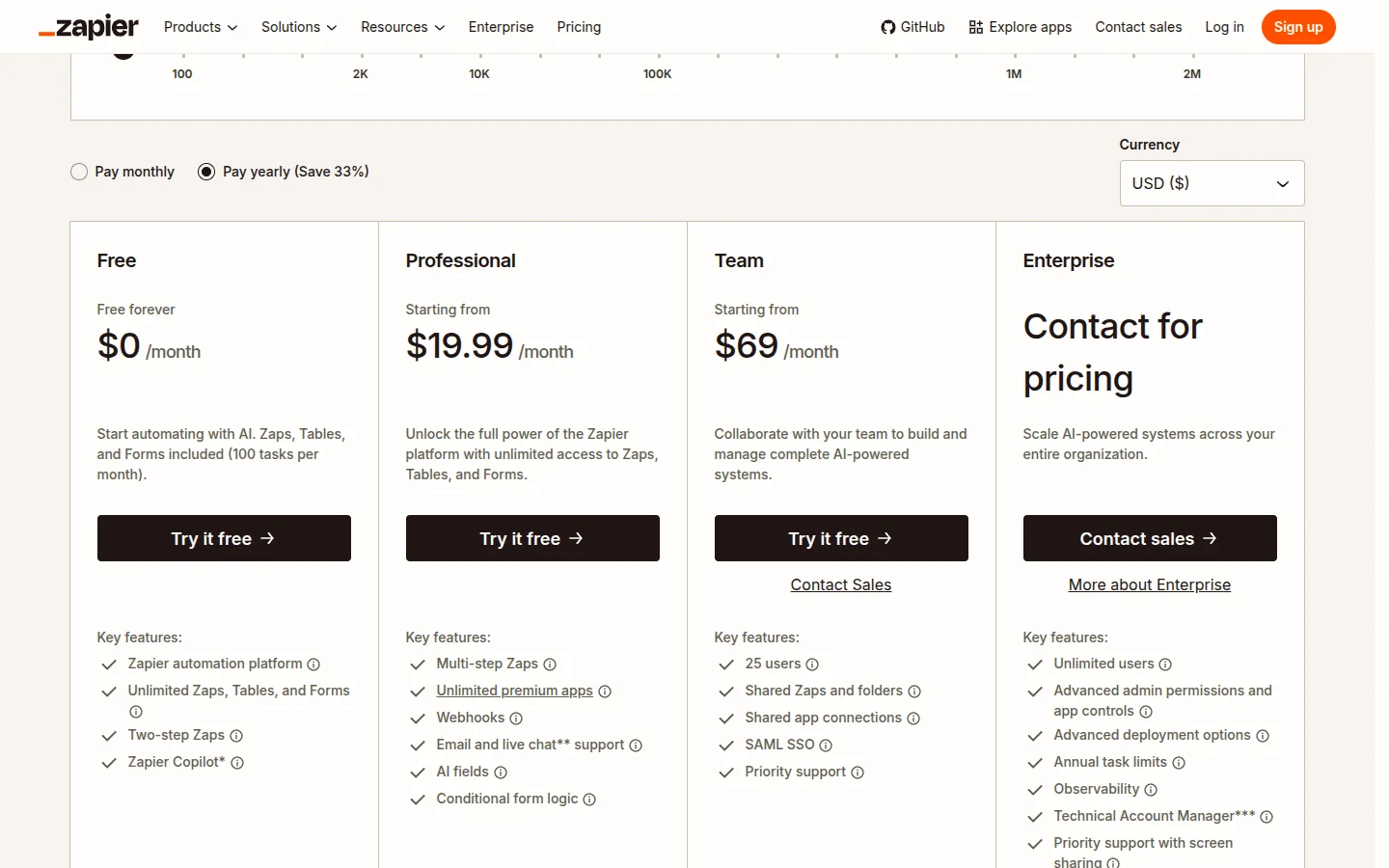
Screenshot of zapier.com/pricing, taken 2026-11-14.
Pros
- The most apps by far
- Code steps and an inbound email address are available on the $0 plan
Cons
- 100 tasks a month and two-step Zaps on Free
- Packages are paid only, and code runs 30 seconds per step on Professional
- Cloud only, and Zap JSON import is Team and Enterprise only
8. n8n, Best for self-hosters who want Code nodes with npm turned on
- Score
- 5/12
- $0 plan
- NoCloud is a trial
n8n is a workflow automation platform with a visual editor and a Code node that runs JavaScript or Python as a step. Its homepage claims "500+ native integrations" and its integrations directory says "2,000+". It ranks last here because of its cloud plan and license, not its editor.

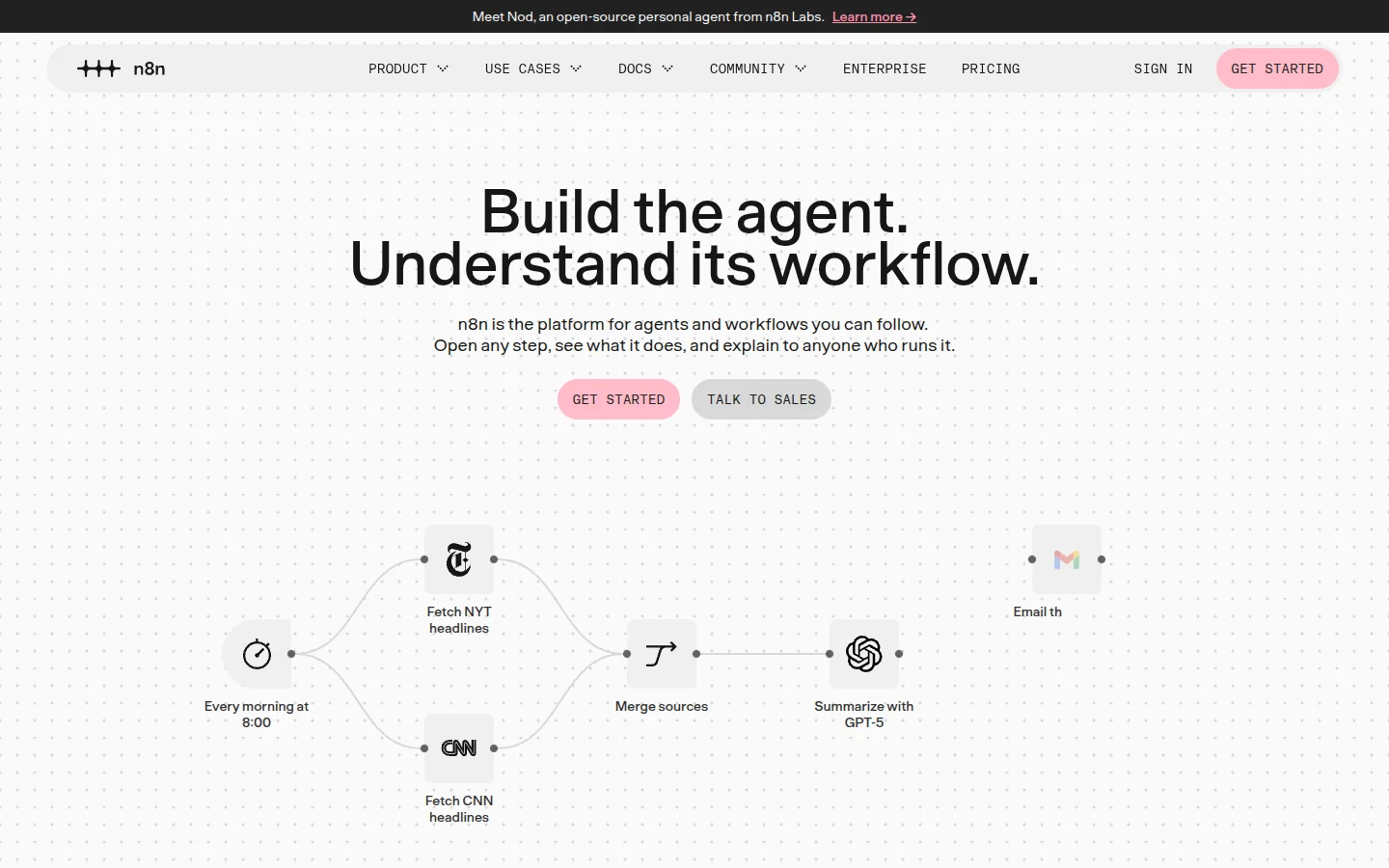
Screenshot of n8n.io, taken 2026-11-14.
On n8n Cloud, "you can't import external npm modules", per the Code node docs. Self-hosted n8n allows them once you set NODE_FUNCTION_ALLOW_EXTERNAL. That's why self-hosting is the better fit for Pipedream users with npm-heavy steps.
Key features
- Code node in JavaScript or Python, in the same workflow as prebuilt nodes
- Webhook trigger and a Schedule Trigger that can run every N seconds
- Email by IMAP polling
- Free Community edition for self-hosting
Best for
- Teams that self-host and want a visual editor with real code steps
- Workflows that need npm modules, once you enable them on your own instance
Pricing n8n Cloud has no $0 plan: the trial gives 1,000 executions with no credit card. Starter is €20 a month billed annually, with 2,500 executions. Self-hosting the Community edition is free (as of November 2026, n8n pricing).
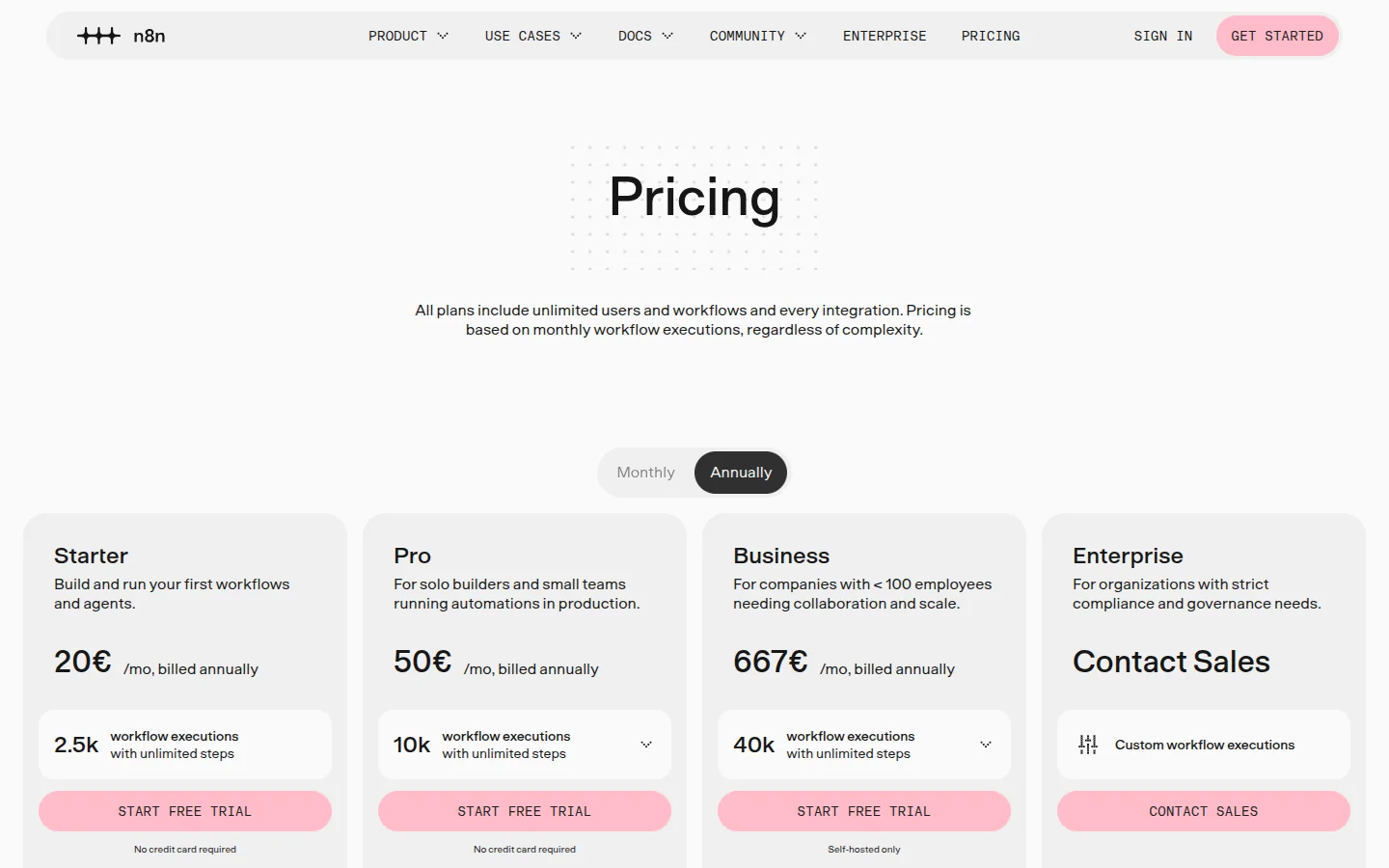
Screenshot of n8n.io/pricing, taken 2026-11-14.
Pros
- One execution per workflow run, however many steps
- A large community and a free self-hosted edition
Cons
- No npm modules on n8n Cloud
- The Sustainable Use License allows use "only for your own internal business purposes or for non-commercial or personal use", per its LICENSE
- No Pipedream guide, and no hosted inbound email address
What we left out, and why
| Left out | Why |
|---|---|
| Inngest | It runs durable functions in TypeScript, Python and Go, but your app hosts the code, it has no prebuilt app actions, and the server is SSPL licensed, per Inngest's GitHub. |
| BuildShip | It has JavaScript nodes and an email trigger, but no $0 plan (a 7-day trial) and "50+ ready-to-use nodes", per buildship.com. |
| Relay.app | It shut down in September 2026, per relay.app. |
| Val Town | It is shutting down too. We ranked Val Town alternatives separately. |
| Deno Deploy | Deno said on October 9, 2026 that Deploy shuts down after six months. See our Deno Deploy alternatives. |
| Node-RED, Huginn and Temporal | No hosted service you can sign up for, or no prebuilt app integrations. |
If you also drew agent workflows on OpenAI's canvas, Agent Builder shuts down sooner, on November 30, 2026; our OpenAI Agent Builder alternatives cover where to move them. Every dated developer shutdown we found, with the vendor's own words, is in our developer service shutdown tracker.
How to migrate from Pipedream before March 31
Finish the move before March 31, 2027, when workflows stop. Export before April 30, 2027, when Pipedream deletes the data. These steps come from Pipedream's export docs.
- Export every project. In each project's settings, click Export Workflows. Pipedream writes a ZIP to the project's File Store with a
manifest.jsonand one JSON file per workflow. One export holds up to 500 workflows or 256 MB. Export needs a plan with File Stores, and Pipedream does not state which plans include them. - Read the manifest warnings.
manifest.jsonlists every workflow, including skipped ones, and itswarningsname "each step and prop that you must re-enter or connect again." - Map each trigger. Each workflow's JSON lists trigger types:
http,timer,email,source(app events) orform.
| Pipedream trigger | In the new tool |
|---|---|
http | A webhook URL |
timer | A cron schedule |
email | A mailhook or an IMAP trigger |
source (app events) | The new tool's app trigger |
- Move code steps. The export includes each code step's code. Node.js steps wrap logic in
defineComponent({ async run({ steps, $ }) }), and Python steps indef handler(pd). Keep the body, then change how it reads the previous step and returns data. - Re-create secrets, env vars and connected accounts. The export leaves out secret props, credentials, OAuth tokens and environment variables ("Re-enter these values on your new platform"). It also leaves out data stores, File Store files and code for private multi-file components.
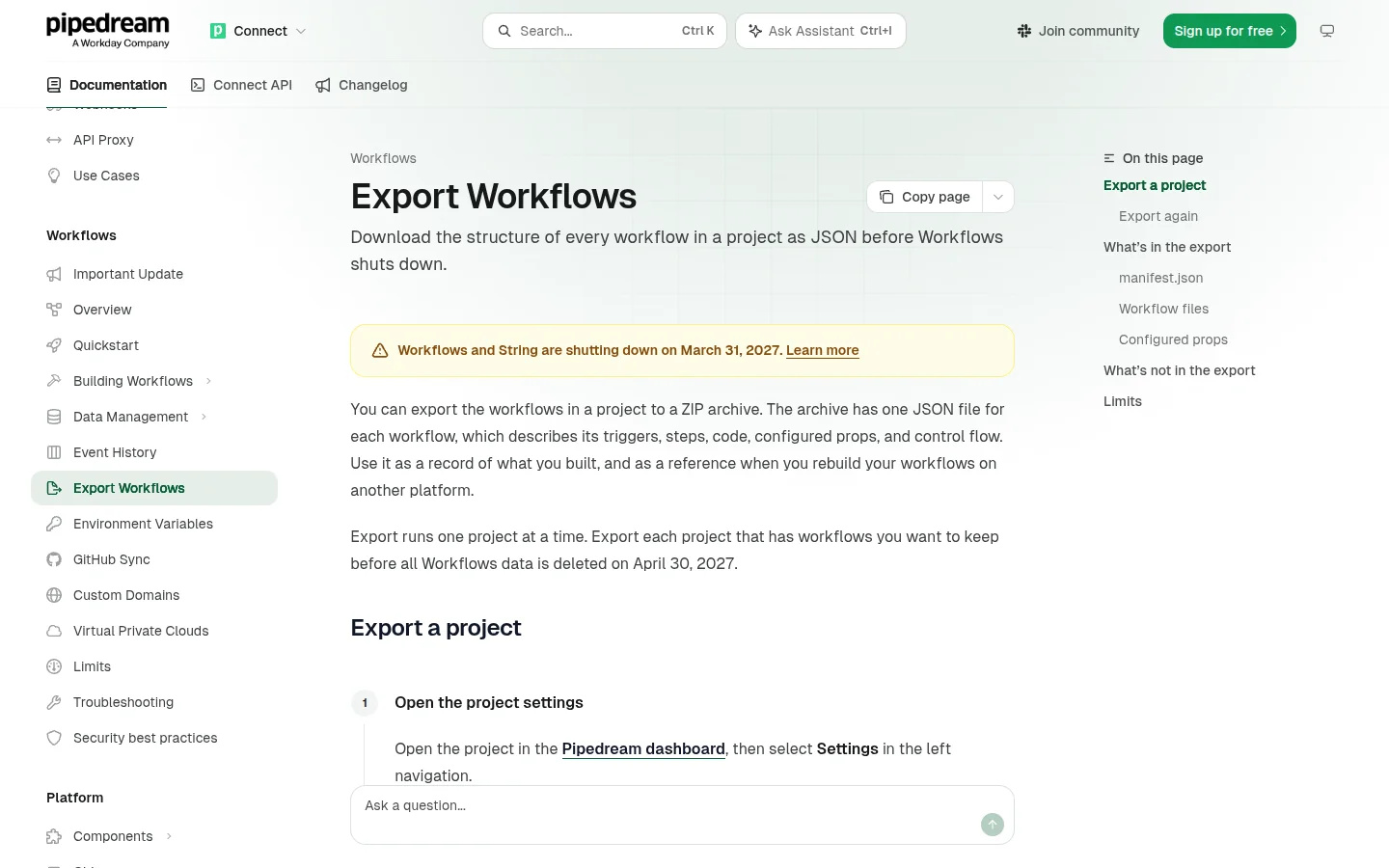
Screenshot of pipedream.com/docs/workflows/export-workflows, taken 2026-11-14.
- Run both side by side, then switch. Keep new schedules off until you've tested, as Windmill's guide does. Then point webhook senders at the new URLs. Pipedream does not state whether its HTTP endpoints can redirect after shutdown.
- Cancel before or on the date. Subscriptions end March 31, 2027 with a prorated refund. Monthly plans can cancel sooner in account settings, and annual plans through support.
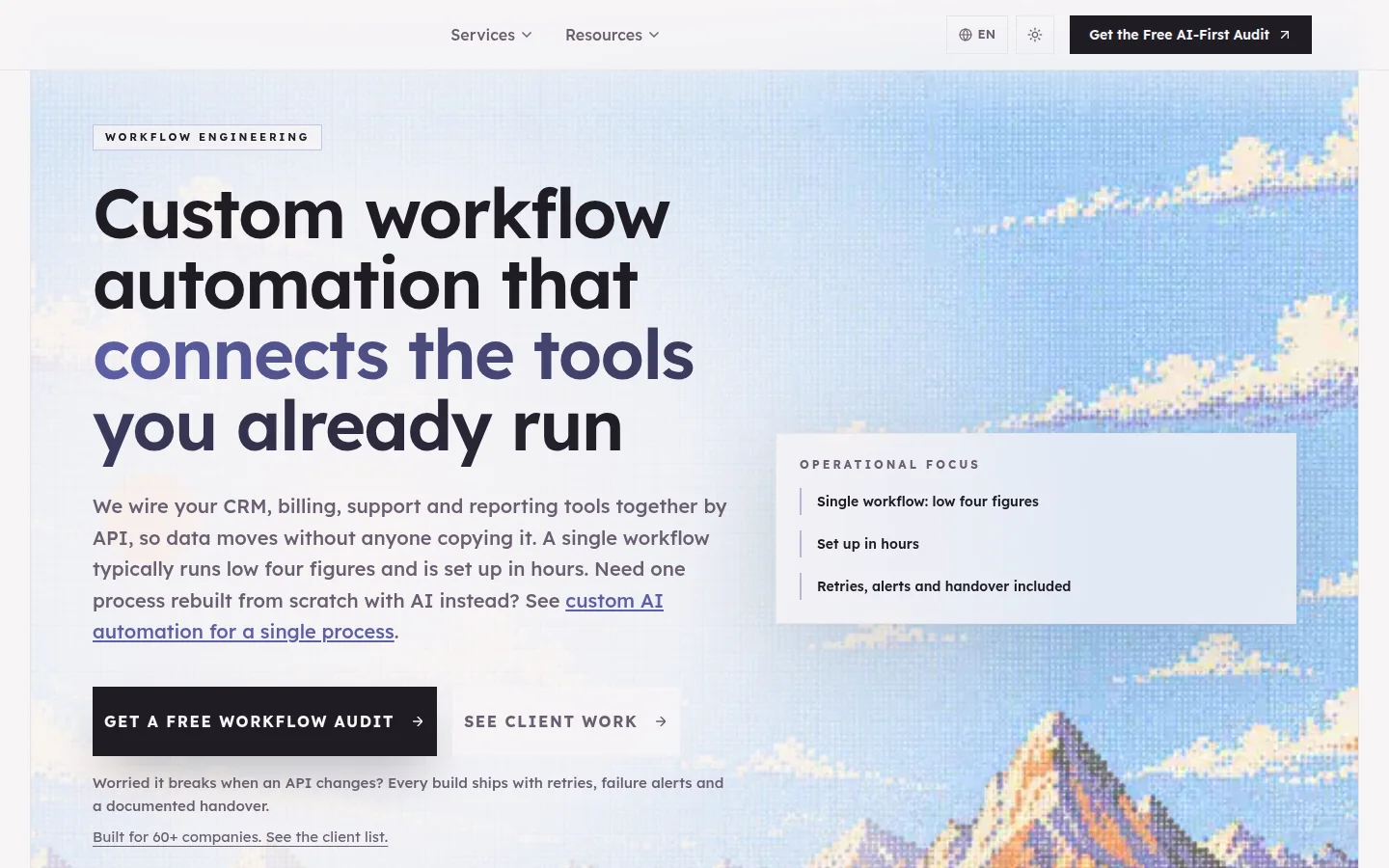
Screenshot of ayautomate.com/services/custom-workflow-automation, taken 2026-11-14.
If you'd rather have someone move your workflows for you: AY Automate is a workflow automation service. Its page says it migrates existing Zapier or Make setups by rebuilding each workflow, and that pricing starts at $3K a month. It is a service, not a workflow tool, so it isn't ranked or scored above.
How to choose a Pipedream alternative
1) Are your workflows mostly code, or mostly prebuilt actions?
Mostly code: pick Windmill if you want steps in the same four languages, or Trigger.dev if you want the code in your own repo. Mostly prebuilt actions: Zapier (9,000+ apps) or Make (3,000+ apps), and accept the limits on code. Kestra sits between them, with 2,600+ plugins and script tasks.
2) Do you need to self-host?
Windmill (AGPLv3), Kestra (Apache-2.0), Activepieces (MIT core) and Trigger.dev (Apache-2.0) are open source. n8n self-hosts for free under the Sustainable Use License, which limits commercial use. Latenode, Make and Zapier are cloud only.
3) Do you use Pipedream's email trigger?
| Email trigger | Tools |
|---|---|
| Its own inbound address for each workflow | Latenode, Make, Zapier and Windmill |
| Polls a mailbox you own over IMAP, so you set one up first | n8n, Kestra and Activepieces |
| No email trigger | Trigger.dev |
4) How many workflows can you rebuild before March 31?
Count them in manifest.json. Windmill, Kestra and Latenode turn the export into a draft for you with an AI agent or Copilot. Everywhere else you rebuild each workflow by hand, so start with the ones that run most often. If that is more than your team can rebuild before March 31, one of the best forward deployed engineering companies can embed an engineer to do it.
Get your dev tool into lists like this one
If you build a developer tool, being named on pages like this one is how developers and AI search find you. AY Listicle puts SaaS products into "best of" listicles that buyers and AI search read, and we check every mention every month. Request a spot on AY Listicle.

Screenshot of aylistcle.com, taken 2026-11-14.
FAQ
When does Pipedream shut down?
Pipedream Workflows shuts down on March 31, 2027, per its docs page "Workflows and String Are Shutting Down on March 31, 2027". All Workflows data, including credentials and OAuth tokens, will be permanently deleted by April 30, 2027. Signups and new subscriptions are already closed.
Is Pipedream Connect shutting down too?
No. Pipedream's pricing docs say "Pipedream Connect is not affected and remains fully supported." The Connect API, MCP servers and API Proxy keep working, and only Workflows and String shut down.
What is the best Pipedream alternative?
Windmill is the best Pipedream alternative for code-heavy workflows: it scored 10 of 12 on our six criteria. It runs TypeScript, Python, Go and Bash steps, has HTTP, schedule and email triggers, is open source, and publishes a guide that rebuilds Pipedream's export. Its weak spot is integrations, at 200+ resource types.
What is the best open-source Pipedream alternative?
Windmill (AGPLv3) and Kestra (Apache-2.0) are the top open-source picks, scoring 10 and 9 of 12. Both publish Pipedream migration guides. Activepieces (MIT core) and Trigger.dev (Apache-2.0) are also open source, and n8n is self-hostable under the source-available Sustainable Use License.
Is there a self-hosted Pipedream alternative?
Yes. Windmill, Kestra, Activepieces, Trigger.dev and n8n all self-host for free. n8n self-hosted allows npm modules in its Code node, which n8n Cloud does not. Make, Zapier and Latenode are cloud only.
Can I import my Pipedream export into another tool?
Not directly. Pipedream calls the export a reference "when you rebuild your workflows on another platform", and no vendor we checked imports it as is. Windmill has your AI coding agent read it, and Kestra and Latenode take it in their AI Copilot.
What does the Pipedream export leave out?
It leaves out secret values, credentials and OAuth tokens, environment variables, event history, data stores, File Store files and code for private multi-file components. Code steps and trigger settings are included. Re-create the rest on the new platform before April 30, 2027.
Is there a free Pipedream alternative?
Yes, with limits. Latenode's $0 plan includes 10,000 CPU seconds a month and all four trigger types, while Windmill Cloud Free has 1,000 executions, Make Free 1,000 credits and Zapier Free 100 tasks. Self-hosting Windmill, Kestra, Activepieces, Trigger.dev or n8n costs $0 in license fees.
Sources: Pipedream Workflows shutdown, Pipedream export docs, Pipedream pricing docs, Windmill pricing, Kestra pricing, Latenode Pipedream page, Trigger.dev scheduled tasks, Activepieces sandboxing, Make Code app, Zapier Code by Zapier, n8n Code node, Inngest pricing. All read November 11, 2026.